


Page 177 - The City and Guilds Textbook: Plumbing Book 1 for the Level 3 Apprenticeship (9189), Level 2 Technical Certificate (8202) and Level 2 Diploma (6035)
P. 177
Chapter 3 Scientific principles
Charles’s law
Charles’s law was discovered by Jacques Charles in 1802. It states that the
volume of a quantity of gas, held at constant pressure, varies directly with the INDUSTRY TIP
kelvin temperature. But what does that mean?
Charles’s law can be
It relates to how gases expand when they are heated up and contract when they
are cooled. In other words, as the temperature of a quantity of gas at constant explained with the following
analogy.
pressure increases, the volume increases. As the temperature goes down, the
volume decreases. If a sealed copper pipe were
pressurised to 20 mb at
Boyle’s law room temperature and then
placed in direct sunlight
Boyle’s law states that the volume of a sample of gas at a given where the pipe could warm
temperature varies inversely with the applied pressure. In other words, up, then the pressure inside
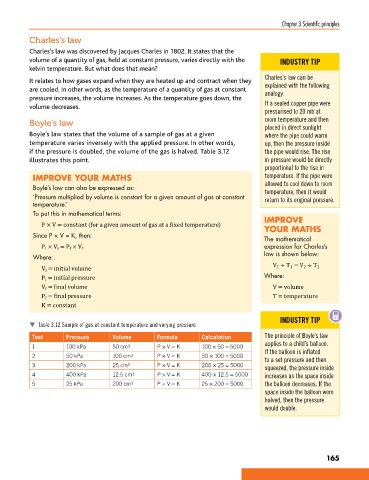
if the pressure is doubled, the volume of the gas is halved. Table 3.12 the pipe would rise. The rise
illustrates this point. in pressure would be directly
proportional to the rise in
IMPROVE YOUR MATHS temperature. If the pipe were
Boyle’s law can also be expressed as: allowed to cool down to room
temperature, then it would
‘Pressure multiplied by volume is constant for a given amount of gas at constant return to its original pressure.
temperature.’
To put this in mathematical terms:
IMPROVE
P × V = constant (for a given amount of gas at a fixed temperature) YOUR MATHS
Since P × V = K, then:
The mathematical
P × V = P × V expression for Charles’s
i i f f
Where: law is shown below:
÷ T = V ÷ T
V 1 1 2 2
= initial volume
V i
Where:
P = initial pressure
i
V = final volume V = volume
f
P = final pressure T = temperature
f
K = constant
INDUSTRY TIP
Table 3.12 Sample of gas at constant temperature and varying pressure
Test Pressure Volume Formula Calculation The principle of Boyle’s law
1 100 kPa 50 cm 3 P × V = K 100 × 50 = 5000 applies to a child’s balloon.
2 50 kPa 100 cm 3 P × V = K 50 × 100 = 5000 If the balloon is inflated
to a set pressure and then
3 200 kPa 25 cm 3 P × V = K 200 × 25 = 5000 squeezed, the pressure inside
4 400 kPa 12.5 cm 3 P × V = K 400 × 12.5 = 5000 increases as the space inside
5 25 kPa 200 cm 3 P × V = K 25 × 200 = 5000 the balloon decreases. If the
space inside the balloon were
halved, then the pressure
would double.
165
9781510416482.indb 165 29/03/19 8:55 PM

