


Page 179 - The City and Guilds Textbook: Plumbing Book 1 for the Level 3 Apprenticeship (9189), Level 2 Technical Certificate (8202) and Level 2 Diploma (6035)
P. 179
Chapter 3 Scientific principles


                celsius or kelvin may be used and, since both scales correspond with each other,
                temperature difference is uniform. In other words, a 1°C temperature difference   INDUSTRY TIP
                is equal to a 1 K temperature difference.
                                                                                            Celsius is named after the
                Measuring temperature                                                       Swedish astronomer, Anders
                                                                                            Celsius (1701–1744). The
                Many methods have been developed for measuring temperature. Most rely       Kelvin scale is named after
                on measuring some physical property of a working material that varies with   the Belfast-born engineer and
                temperature. Temperature measuring devices include the following.           physicist William Thomson,
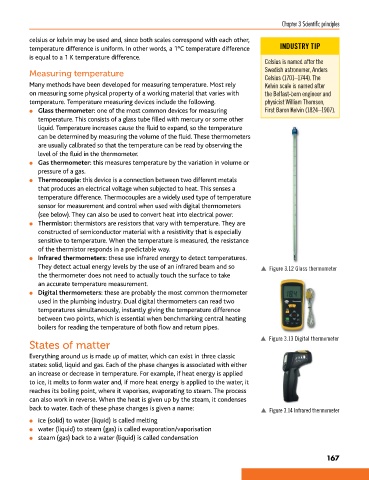
                l  Glass thermometer: one of the most common devices for measuring          First Baron Kelvin (1824–1907).
                   temperature. This consists of a glass tube filled with mercury or some other
                   liquid. Temperature increases cause the fluid to expand, so the temperature
                   can be determined by measuring the volume of the fluid. These thermometers
                   are usually calibrated so that the temperature can be read by observing the
                   level of the fluid in the thermometer.
                l  Gas thermometer: this measures temperature by the variation in volume or
                   pressure of a gas.
                l  Thermocouple: this device is a connection between two different metals
                   that produces an electrical voltage when subjected to heat. This senses a
                   temperature difference. Thermocouples are a widely used type of temperature
                   sensor for measurement and control when used with digital thermometers
                   (see below). They can also be used to convert heat into electrical power.
                l  Thermistor: thermistors are resistors that vary with temperature. They are
                   constructed of semiconductor material with a resistivity that is especially
                   sensitive to temperature. When the temperature is measured, the resistance
                   of the thermistor responds in a predictable way.
                l  Infrared thermometers: these use infrared energy to detect temperatures.
                   They detect actual energy levels by the use of an infrared beam and so   p  Figure 3.12 Glass thermometer
                   the thermometer does not need to actually touch the surface to take
                   an accurate temperature measurement.
                l  Digital thermometers: these are probably the most common thermometer
                   used in the plumbing industry. Dual digital thermometers can read two
                   temperatures simultaneously, instantly giving the temperature difference
                   between two points, which is essential when benchmarking central heating
                   boilers for reading the temperature of both flow and return pipes.
                                                                                           p  Figure 3.13 Digital thermometer
                States of matter

                Everything around us is made up of matter, which can exist in three classic
                states: solid, liquid and gas. Each of the phase changes is associated with either
                an increase or decrease in temperature. For example, if heat energy is applied
                to ice, it melts to form water and, if more heat energy is applied to the water, it
                reaches its boiling point, where it vaporises, evaporating to steam. The process
                can also work in reverse. When the heat is given up by the steam, it condenses
                back to water. Each of these phase changes is given a name:                p  Figure 3.14 Infrared thermometer

                l  ice (solid) to water (liquid) is called melting
                l  water (liquid) to steam (gas) is called evaporation/vaporisation
                l  steam (gas) back to a water (liquid) is called condensation


                                                                                                                167


        9781510416482.indb   167                                                                                    29/03/19   8:55 PM

