


Page 200 - The City and Guilds Textbook: Plumbing Book 1 for the Level 3 Apprenticeship (9189), Level 2 Technical Certificate (8202) and Level 2 Diploma (6035)
P. 200
The City & Guilds Textbook: Plumbing Book 1
direction. This directional movement of electrons due to an electromotive
force (EMF) is known as electricity. How well a material allows electron
movement is called conductivity, and how well it resists electron flow is
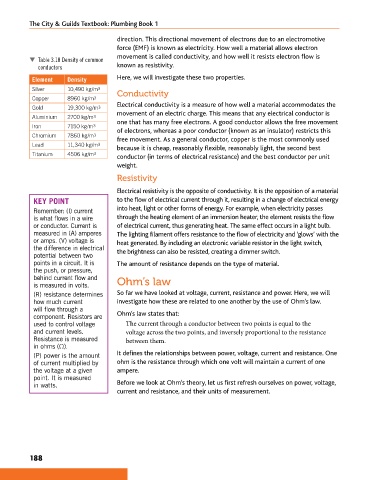
Table 3.18 Density of common
conductors known as resistivity.
Element Density Here, we will investigate these two properties.
Silver 10,490 kg/m 3 Conductivity
Copper 8960 kg/m 3
Electrical conductivity is a measure of how well a material accommodates the
Gold 19,300 kg/m 3
movement of an electric charge. This means that any electrical conductor is
Aluminium 2700 kg/m 3
Iron 7150 kg/m 3 one that has many free electrons. A good conductor allows the free movement
Chromium 7860 kg/m 3 of electrons, whereas a poor conductor (known as an insulator) restricts this
free movement. As a general conductor, copper is the most commonly used
Lead 11,340 kg/m 3 because it is cheap, reasonably flexible, reasonably light, the second best
Titanium 4506 kg/m 3 conductor (in terms of electrical resistance) and the best conductor per unit
weight.
Resistivity
Electrical resistivity is the opposite of conductivity. It is the opposition of a material
KEY POINT to the flow of electrical current through it, resulting in a change of electrical energy
Remember: (I) current into heat, light or other forms of energy. For example, when electricity passes
is what flows in a wire through the heating element of an immersion heater, the element resists the flow
or conductor. Current is of electrical current, thus generating heat. The same effect occurs in a light bulb.
measured in (A) amperes The lighting filament offers resistance to the flow of electricity and ‘glows’ with the
or amps. (V) voltage is heat generated. By including an electronic variable resistor in the light switch,
the difference in electrical the brightness can also be resisted, creating a dimmer switch.
potential between two
points in a circuit. It is The amount of resistance depends on the type of material.
the push, or pressure,
behind current flow and Ohm’s law
is measured in volts.
(R) resistance determines So far we have looked at voltage, current, resistance and power. Here, we will
how much current investigate how these are related to one another by the use of Ohm’s law.
will flow through a
component. Resistors are Ohm’s law states that:
used to control voltage The current through a conductor between two points is equal to the
and current levels. voltage across the two points, and inversely proportional to the resistance
Resistance is measured between them.
in ohms (Ω).
(P) power is the amount It defines the relationships between power, voltage, current and resistance. One
of current multiplied by ohm is the resistance through which one volt will maintain a current of one
the voltage at a given ampere.
point. It is measured
in watts. Before we look at Ohm’s theory, let us first refresh ourselves on power, voltage,
current and resistance, and their units of measurement.
188
9781510416482.indb 188 29/03/19 8:55 PM

