


Page 199 - The City and Guilds Textbook: Plumbing Book 1 for the Level 3 Apprenticeship (9189), Level 2 Technical Certificate (8202) and Level 2 Diploma (6035)
P. 199
Chapter 3 Scientific principles

                Direct current

                In a direct current (DC) circuit the electrons always flow from the negative (−)   p  Figure 3.37 Direct current symbol
                pole towards the positive (+) pole. The polarity, or direction, of the electrons
                never reverses. DC can be produced from a number of sources, including
                electrochemical, photovoltaic cells and batteries. DC can be stored in batteries
                and cells.

                Alternating current

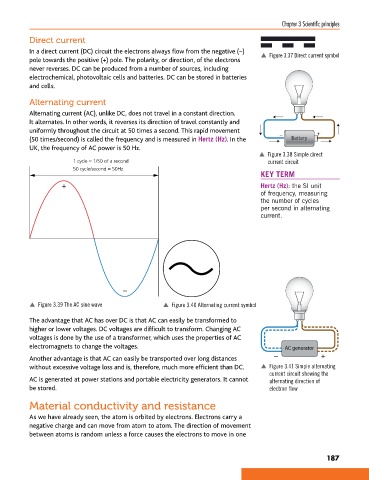
                Alternating current (AC), unlike DC, does not travel in a constant direction.
                It alternates. In other words, it reverses its direction of travel constantly and
                uniformly throughout the circuit at 50 times a second. This rapid movement       _           +
                (50 times/second) is called the frequency and is measured in Hertz (Hz). In the      Battery
                UK, the frequency of AC power is 50 Hz.
                                                                                          p  Figure 3.38 Simple direct
                              1 cycle = 1/50 of a second                                     current circuit
                              50 cycle/second = 50Hz
                                                                                           KEY TERM
                          +                                                                Hertz (Hz): the SI unit
                                                                                           of frequency, measuring
                                                                                           the number of cycles
                                                                                           per second in alternating
                                                                                           current.


                                              −

                p  Figure 3.39 The AC sine wave            p  Figure 3.40 Alternating current symbol

                The advantage that AC has over DC is that AC can easily be transformed to
                higher or lower voltages. DC voltages are difficult to transform. Changing AC
                voltages is done by the use of a transformer, which uses the properties of AC
                electromagnets to change the voltages.                                             AC generator
                Another advantage is that AC can easily be transported over long distances
                without excessive voltage loss and is, therefore, much more efficient than DC.  p  Figure 3.41 Simple alternating
                                                                                              current circuit showing the
                AC is generated at power stations and portable electricity generators. It cannot   alternating direction of
                be stored.                                                                    electron flow

                Material conductivity and resistance

                As we have already seen, the atom is orbited by electrons. Electrons carry a
                negative charge and can move from atom to atom. The direction of movement
                between atoms is random unless a force causes the electrons to move in one


                                                                                                                187


        9781510416482.indb   187                                                                                    29/03/19   8:55 PM

