


Page 482 - The City and Guilds Textbook: Plumbing Book 1 for the Level 3 Apprenticeship (9189), Level 2 Technical Certificate (8202) and Level 2 Diploma (6035)
P. 482
The City & Guilds Textbook: Plumbing Book 1


                                            3  Split the valves at the valve unions and wrap PTFE tape around the valve
                                               tail. Between 10 and 15 wraps will ensure the joint between tail and radiator
                                               does not leak. This may seem an awful lot of PTFE but the ½-inch female
                                               sockets on radiators are notoriously slightly oversized and this leads to leaks.
                                            4  Make the tail into the radiator using a radiator spanner.
                                            5  Insert and tighten the air release valve and plug using an adjustable spanner.

                                            Domestic panel radiators have ½-inch BSP female threads at either side, top
                                            and bottom, and these will accept a variety of radiator valves. One end of the
                                            radiator has an air release valve, with the other end being blanked by the use of
                                            a plug. These are usually supplied by the radiator manufacturer.

                                            Column radiators

                                            Column radiators (often known as hospital or church radiators) have been
                                            available for many years. As the name suggests, they are made up of columns;
                                            the more columns the radiator has, the better the heat output. They are
                                            increasingly being used with modern heating systems, especially on period
                                            refurbishments.
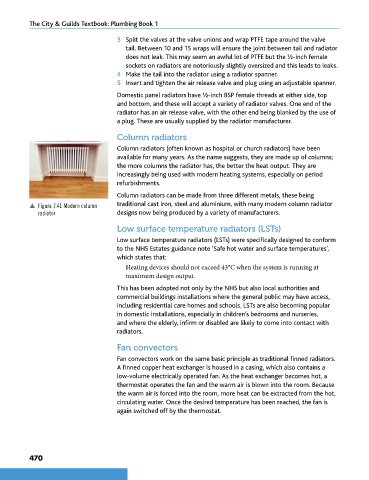
                                            Column radiators can be made from three different metals, these being
                p  Figure 7.41 Modern column   traditional cast iron, steel and aluminium, with many modern column radiator
                   radiator                 designs now being produced by a variety of manufacturers.

                                            Low surface temperature radiators (LSTs)
                                            Low surface temperature radiators (LSTs) were specifically designed to conform
                                            to the NHS Estates guidance note ‘Safe hot water and surface temperatures’,
                                            which states that:
                                               Heating devices should not exceed 43°C when the system is running at
                                               maximum design output.

                                            This has been adopted not only by the NHS but also local authorities and
                                            commercial buildings installations where the general public may have access,
                                            including residential care homes and schools. LSTs are also becoming popular
                                            in domestic installations, especially in children’s bedrooms and nurseries,
                                            and where the elderly, infirm or disabled are likely to come into contact with
                                            radiators.

                                            Fan convectors
                                            Fan convectors work on the same basic principle as traditional finned radiators.
                                            A finned copper heat exchanger is housed in a casing, which also contains a
                                            low-volume electrically operated fan. As the heat exchanger becomes hot, a
                                            thermostat operates the fan and the warm air is blown into the room. Because
                                            the warm air is forced into the room, more heat can be extracted from the hot,
                                            circulating water. Once the desired temperature has been reached, the fan is
                                            again switched off by the thermostat.


                470


        9781510416482.indb   470                                                                                    29/03/19   9:03 PM

