


Page 483 - The City and Guilds Textbook: Plumbing Book 1 for the Level 3 Apprenticeship (9189), Level 2 Technical Certificate (8202) and Level 2 Diploma (6035)
P. 483
Chapter 7 Central heating systems

                Fan convectors tend to be larger than traditional radiators and they also require
                a mains electric connection, usually via a switched fuse spur. There are two
                separate types of fan convector, as follows.
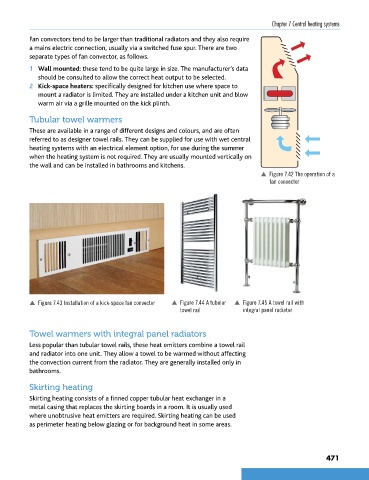
                1  Wall mounted: these tend to be quite large in size. The manufacturer’s data
                   should be consulted to allow the correct heat output to be selected.
                2  Kick-space heaters: specifically designed for kitchen use where space to
                   mount a radiator is limited. They are installed under a kitchen unit and blow
                   warm air via a grille mounted on the kick plinth.
                Tubular towel warmers

                These are available in a range of different designs and colours, and are often
                referred to as designer towel rails. They can be supplied for use with wet central
                heating systems with an electrical element option, for use during the summer
                when the heating system is not required. They are usually mounted vertically on
                the wall and can be installed in bathrooms and kitchens.
                                                                                           p  Figure 7.42 The operation of a
                                                                                              fan convector


                p  Figure 7.43 Installation of a kick-space fan convector  p  Figure 7.44 A tubular   p  Figure 7.45 A towel rail with
                                                                 towel rail          integral panel radiator


                Towel warmers with integral panel radiators
                Less popular than tubular towel rails, these heat emitters combine a towel rail
                and radiator into one unit. They allow a towel to be warmed without affecting
                the convection current from the radiator. They are generally installed only in
                bathrooms.
                Skirting heating

                Skirting heating consists of a finned copper tubular heat exchanger in a
                metal casing that replaces the skirting boards in a room. It is usually used
                where unobtrusive heat emitters are required. Skirting heating can be used
                as perimeter heating below glazing or for background heat in some areas.


                                                                                                                471


        9781510416482.indb   471                                                                                    29/03/19   9:03 PM

