


Page 479 - The City and Guilds Textbook: Plumbing Book 1 for the Level 3 Apprenticeship (9189), Level 2 Technical Certificate (8202) and Level 2 Diploma (6035)
P. 479
Chapter 7 Central heating systems

                l  fan convectors                                                           KEY POINT
                   l  wall mounted
                   l  kick space                                                            Radiator standard BS
                l  towel warmers                                                            EN 442
                l  towel warmers with integral panel radiators                              Radiators must now
                                                                                            meet the above BS
                l  skirting heating.                                                        EN number, which
                                                                                            supersedes the old
                Panel radiators                                                             British Standard which

                Modern panel convectors/radiators are designed to emit heat by convection   was BS 3528. After years
                and radiation (refer to Chapter 3, Scientific principles, to read more about this);   of testing in Europe the
                                                                                            certification of ‘rads’ was
                70 per cent of the heat is convected. They have fins (often called a convector)   brought up to date to
                welded to the back of the radiator, which serve to warm the cold air that passes   ensure that all radiators
                through them, creating warm air currents, which flow into the room. This    met the minimum
                dramatically improves the efficiency of the radiator. Steel radiators that do not   thickness, pressure
                have fins rely on radiant heat alone and this leads to cold spots in the room.   tolerance, treatment and
                Positioning of the radiator is, therefore, critical. Radiators should be sited on   paint quality which helps
                                                                                            with limiting corrosion.
                a clear wall with no obstructions, such as window sills, above it. If this is not   Under these tests, the
                possible, enough space should be left between the top of the radiator and the   technical committee
                obstruction to allow the warm air to circulate.                             responsible for the

                It is recommended by radiator manufacturers that radiators should be fitted at   changes use something
                                                                                            called Delta T (ΔT) to set
                least 150 mm from finished floor level to the bottom of the radiator (depending   the new standard. Delta
                on the height of the skirting board), to allow air circulation.             T defines the difference
                                                                                            between the water (delta)
                Connections to radiators                                                    temperature in the
                Radiator connections are classified by their abbreviations. For example:    radiator and the ambient
                                                                                            air temperature (T) in a
                l  TBOE means top bottom opposite end (used on heat sink radiators with solid   room. As water passes
                   fuel systems and one-pipe systems)                                       from the flow and returns
                l  BBOE means bottom bottom opposite end (the usual method of radiator      through the radiator it
                   connection)                                                              will give away the energy
                l  TBSE means top bottom same end (used with some one-pipe systems).        it has obtained from the
                                                                                            boiler. Delta T is set to
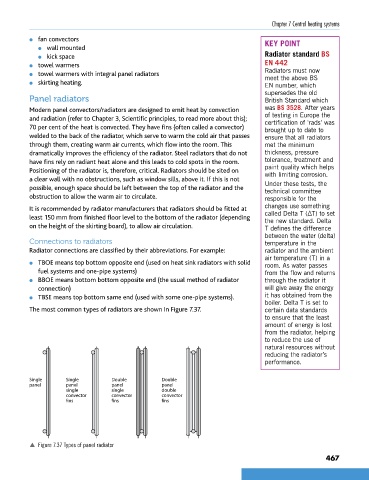
                The most common types of radiators are shown In Figure 7.37.                certain data standards
                                                                                            to ensure that the least
                                                                                            amount of energy is lost
                                                                                            from the radiator, helping
                                                                                            to reduce the use of
                                                                                            natural resources without
                                                                                            reducing the radiator’s
                                                                                            performance.


                Single      Single        Double           Double
                panel       panel         panel            panel
                            single        single           double
                            convector     convector        convector
                            fins          fins             fins


                p  Figure 7.37 Types of panel radiator

                                                                                                                467


        9781510416482.indb   467                                                                                    29/03/19   9:03 PM

