


Page 542 - The City and Guilds Textbook: Plumbing Book 1 for the Level 3 Apprenticeship (9189), Level 2 Technical Certificate (8202) and Level 2 Diploma (6035)
P. 542
The City & Guilds Textbook: Plumbing Book 1


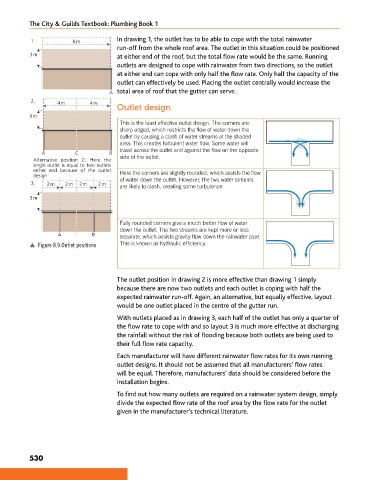
                1.            8m            In drawing 1, the outlet has to be able to cope with the total rainwater
                                            run-off from the whole roof area. The outlet in this situation could be positioned
                3 m                         at either end of the roof, but the total flow rate would be the same. Running
                                            outlets are designed to cope with rainwater from two directions, so the outlet
                                            at either end can cope with only half the flow rate. Only half the capacity of the
                                            outlet can effectively be used. Placing the outlet centrally would increase the

                                          A  total area of roof that the gutter can serve.
                2.       4 m        4m
                                            Outlet design
                3 m
                                             This is the least effective outlet design. The corners are
                                             sharp edged, which restricts the flow of water down the
                                             outlet by causing a clash of water streams at the shaded
                                             area. This creates turbulent water flow. Some water will
                                             travel across the outlet and against the flow on the opposite
                    A          C          B  side of the outlet.
                 Alternative position C: Here the
                 single outlet is equal to two outlets
                 either  end  because  of  the  outlet   Here the corners are slightly rounded, which assists the flow
                 design
                3.    2 m   2m  2m    2m     of water down the outlet. However, the two water streams
                                             are likely to clash, creating some turbulence.
                3 m


                                             Fully rounded corners give a much better flow of water
                                             down the outlet. The two streams are kept more or less
                         A          B        separate, which assists gravity flow down the rainwater pipe.
                p  Figure 8.9 Outlet positions  This is known as hydraulic efficiency.


                                            The outlet position in drawing 2 is more effective than drawing 1 simply
                                            because there are now two outlets and each outlet is coping with half the
                                            expected rainwater run-off. Again, an alternative, but equally effective, layout
                                            would be one outlet placed in the centre of the gutter run.

                                            With outlets placed as in drawing 3, each half of the outlet has only a quarter of
                                            the flow rate to cope with and so layout 3 is much more effective at discharging
                                            the rainfall without the risk of flooding because both outlets are being used to
                                            their full flow rate capacity.
                                            Each manufacturer will have different rainwater flow rates for its own running
                                            outlet designs. It should not be assumed that all manufacturers’ flow rates
                                            will be equal. Therefore, manufacturers’ data should be considered before the
                                            installation begins.
                                            To find out how many outlets are required on a rainwater system design, simply
                                            divide the expected flow rate of the roof area by the flow rate for the outlet
                                            given in the manufacturer’s technical literature.


                530


        9781510416482.indb   530                                                                                    29/03/19   9:04 PM

