


Page 69 - The City and Guilds Textbook: Plumbing Book 1 for the Level 3 Apprenticeship (9189), Level 2 Technical Certificate (8202) and Level 2 Diploma (6035)
P. 69
Chapter 1 Health and safety practices and systems

                LPG regulators, hoses and blowtorches
                Most blowtorches that we use today require a regulator to control the amount
                of gas that flows from the cylinder and a hose that connects from the regulator
                to the blowtorch. The regulator should have an adjustable pressure setting
                control. High-pressure hoses are usually coloured orange and are manufactured
                to BS 3212.
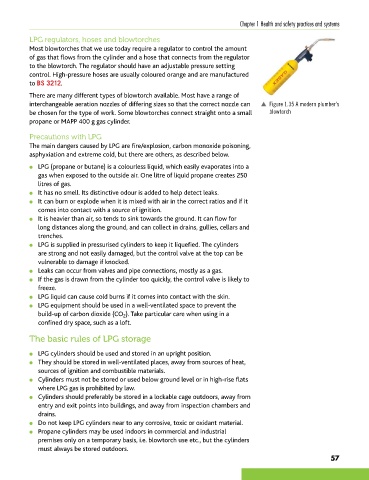
                There are many different types of blowtorch available. Most have a range of
                interchangeable aeration nozzles of differing sizes so that the correct nozzle can   p  Figure 1.35 A modern plumber’s
                be chosen for the type of work. Some blowtorches connect straight onto a small   blowtorch
                propane or MAPP 400 g gas cylinder.

                Precautions with LPG
                The main dangers caused by LPG are fire/explosion, carbon monoxide poisoning,
                asphyxiation and extreme cold, but there are others, as described below.
                ●  LPG (propane or butane) is a colourless liquid, which easily evaporates into a
                   gas when exposed to the outside air. One litre of liquid propane creates 250
                   litres of gas.
                ●  It has no smell. Its distinctive odour is added to help detect leaks.
                ●  It can burn or explode when it is mixed with air in the correct ratios and if it
                   comes into contact with a source of ignition.
                ●  It is heavier than air, so tends to sink towards the ground. It can flow for
                   long distances along the ground, and can collect in drains, gullies, cellars and
                   trenches.
                ●  LPG is supplied in pressurised cylinders to keep it liquefied. The cylinders
                   are strong and not easily damaged, but the control valve at the top can be
                   vulnerable to damage if knocked.
                ●  Leaks can occur from valves and pipe connections, mostly as a gas.
                ●  If the gas is drawn from the cylinder too quickly, the control valve is likely to
                   freeze.
                ●  LPG liquid can cause cold burns if it comes into contact with the skin.
                ●  LPG equipment should be used in a well-ventilated space to prevent the
                   build-up of carbon dioxide (CO ). Take particular care when using in a
                                              2
                   confined dry space, such as a loft.

                The basic rules of LPG storage

                ●  LPG cylinders should be used and stored in an upright position.
                ●  They should be stored in well-ventilated places, away from sources of heat,
                   sources of ignition and combustible materials.
                ●  Cylinders must not be stored or used below ground level or in high-rise flats
                   where LPG gas is prohibited by law.
                ●  Cylinders should preferably be stored in a lockable cage outdoors, away from
                   entry and exit points into buildings, and away from inspection chambers and
                   drains.
                ●  Do not keep LPG cylinders near to any corrosive, toxic or oxidant material.
                ●  Propane cylinders may be used indoors in commercial and industrial
                   premises only on a temporary basis, i.e. blowtorch use etc., but the cylinders
                   must always be stored outdoors.
                                                                                                                 57


        9781510416482.indb   57                                                                                     29/03/19   8:50 PM

