


Page 73 - The City and Guilds Textbook: Plumbing Book 1 for the Level 3 Apprenticeship (9189), Level 2 Technical Certificate (8202) and Level 2 Diploma (6035)
P. 73
Chapter 1 Health and safety practices and systems

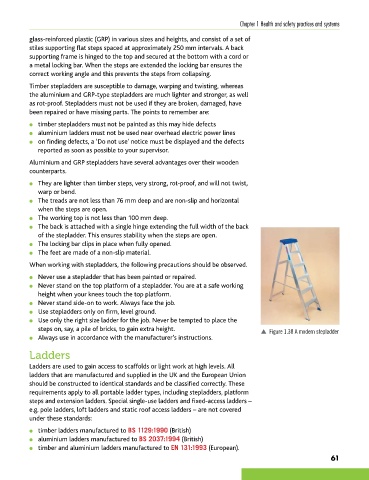
                glass-reinforced plastic (GRP) in various sizes and heights, and consist of a set of
                stiles supporting flat steps spaced at approximately 250 mm intervals. A back
                supporting frame is hinged to the top and secured at the bottom with a cord or
                a metal locking bar. When the steps are extended the locking bar ensures the
                correct working angle and this prevents the steps from collapsing.
                Timber stepladders are susceptible to damage, warping and twisting, whereas
                the aluminium and GRP-type stepladders are much lighter and stronger, as well
                as rot-proof. Stepladders must not be used if they are broken, damaged, have
                been repaired or have missing parts. The points to remember are:

                ●  timber stepladders must not be painted as this may hide defects
                ●  aluminium ladders must not be used near overhead electric power lines
                ●  on finding defects, a ‘Do not use’ notice must be displayed and the defects
                   reported as soon as possible to your supervisor.
                Aluminium and GRP stepladders have several advantages over their wooden
                counterparts.

                ●  They are lighter than timber steps, very strong, rot-proof, and will not twist,
                   warp or bend.
                ●  The treads are not less than 76 mm deep and are non-slip and horizontal
                   when the steps are open.
                ●  The working top is not less than 100 mm deep.
                ●  The back is attached with a single hinge extending the full width of the back
                   of the stepladder. This ensures stability when the steps are open.
                ●  The locking bar clips in place when fully opened.
                ●  The feet are made of a non-slip material.
                When working with stepladders, the following precautions should be observed.
                ●  Never use a stepladder that has been painted or repaired.
                ●  Never stand on the top platform of a stepladder. You are at a safe working
                   height when your knees touch the top platform.
                ●  Never stand side-on to work. Always face the job.
                ●  Use stepladders only on firm, level ground.
                ●  Use only the right size ladder for the job. Never be tempted to place the
                   steps on, say, a pile of bricks, to gain extra height.                  p  Figure 1.38 A modern stepladder
                ●  Always use in accordance with the manufacturer’s instructions.

                Ladders

                Ladders are used to gain access to scaffolds or light work at high levels. All
                ladders that are manufactured and supplied in the UK and the European Union
                should be constructed to identical standards and be classified correctly. These
                requirements apply to all portable ladder types, including stepladders, platform
                steps and extension ladders. Special single-use ladders and fixed-access ladders –
                e.g. pole ladders, loft ladders and static roof access ladders – are not covered
                under these standards:

                ●  timber ladders manufactured to BS 1129:1990 (British)
                ●  aluminium ladders manufactured to BS 2037:1994 (British)
                ●  timber and aluminium ladders manufactured to EN 131:1993 (European).
                                                                                                                 61


        9781510416482.indb   61                                                                                     29/03/19   8:50 PM

