


Page 71 - The City and Guilds Textbook: Plumbing Book 1 for the Level 3 Apprenticeship (9189), Level 2 Technical Certificate (8202) and Level 2 Diploma (6035)
P. 71
Chapter 1 Health and safety practices and systems
● always using heatproof mats when soldering next to wall coverings and
skirting boards
● moving furniture and carpets away from the soldering area
● never pointing your blowtorch directly at combustible materials
● when soldering joints under a suspended floor, before you solder checking to
make sure there is nothing that could catch fire
● never replacing floorboards etc. after soldering activities until you are sure
there is nothing smouldering underneath the floor; wait at least an hour
● when lead welding on a flat roof, damping off the substrate before welding
begins.
Classes of fire and fire extinguisher
There are six classes of fire (as shown in Table 1.9), each involving a different
source of fuel. Because of this, each class of fire requires a different class of fire
extinguisher, although some extinguishers can be used on more than one class
of fire.
Table 1.9 The six classes of fire
Class A SOLIDS such as paper, wood, plastic
Class B FLAMMABLE LIQUIDS such as paraffin, petrol, oil
Class C FLAMMABLE GASES such as propane, butane, methane
Class D METALS such as aluminium, magnesium, titanium
Class E Fires involving ELECTRICAL APPARATUS
Class F Cooking OIL and FAT, etc.
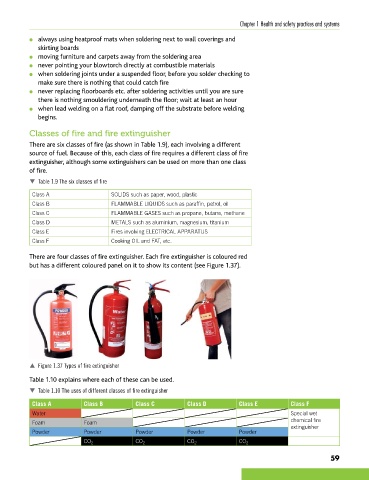
There are four classes of fire extinguisher. Each fire extinguisher is coloured red
but has a different coloured panel on it to show its content (see Figure 1.37).
p Figure 1.37 Types of fire extinguisher
Table 1.10 explains where each of these can be used.
Table 1.10 The uses of different classes of fire extinguisher
Class A Class B Class C Class D Class E Class F
Water Special wet
Foam Foam chemical fire
extinguisher
Powder Powder Powder Powder Powder
CO 2 CO 2 CO 2 CO 2
59
9781510416482.indb 59 29/03/19 8:50 PM

