


Page 70 - The City and Guilds Textbook: Plumbing Book 1 for the Level 3 Apprenticeship (9189), Level 2 Technical Certificate (8202) and Level 2 Diploma (6035)
P. 70
The City & Guilds Textbook: Plumbing Book 1

                                            ●  When connecting hoses and blowtorches, always check for leaks with a
                                               suitable leak-detection fluid.
                                            ●  Always turn the cylinder off at the control valve when it is not in use.

                                            Fire safety
                                            An important part of learning and understanding fuel gases such as propane and
                                            acetylene is awareness of what they produce as an end result: fire.

                                            Fire is one of the most destructive elements known to man and it is something
                                            that plumbers risk on an almost daily basis when we solder, braze and weld.
                                            But what is combustion? What are the circumstances that are needed before
                                            combustion and the resulting fire takes place? How can we control it and reduce
                                            the risk of it occurring? And what do we do if a fire breaks out?


                                            Combustion
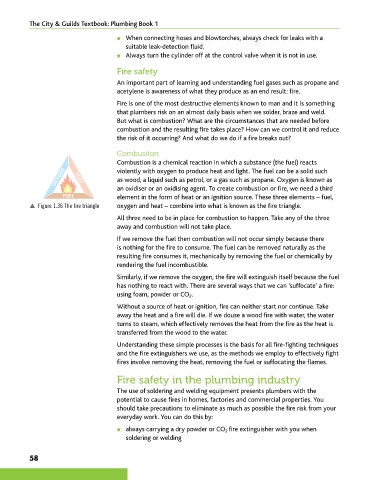
                                            Combustion is a chemical reaction in which a substance (the fuel) reacts
                        OXYGEN  HEAT        violently with oxygen to produce heat and light. The fuel can be a solid such
                                            as wood, a liquid such as petrol, or a gas such as propane. Oxygen is known as
                                            an oxidiser or an oxidising agent. To create combustion or fire, we need a third
                           FUEL             element in the form of heat or an ignition source. These three elements – fuel,
                p  Figure 1.36 The fire triangle  oxygen and heat – combine into what is known as the fire triangle.

                                            All three need to be in place for combustion to happen. Take any of the three
                                            away and combustion will not take place.

                                            If we remove the fuel then combustion will not occur simply because there
                                            is nothing for the fire to consume. The fuel can be removed naturally as the
                                            resulting fire consumes it, mechanically by removing the fuel or chemically by
                                            rendering the fuel incombustible.

                                            Similarly, if we remove the oxygen, the fire will extinguish itself because the fuel
                                            has nothing to react with. There are several ways that we can ‘suffocate’ a fire:
                                            using foam, powder or CO .
                                                                    2
                                            Without a source of heat or ignition, fire can neither start nor continue. Take
                                            away the heat and a fire will die. If we douse a wood fire with water, the water
                                            turns to steam, which effectively removes the heat from the fire as the heat is
                                            transferred from the wood to the water.
                                            Understanding these simple processes is the basis for all fire-fighting techniques
                                            and the fire extinguishers we use, as the methods we employ to effectively fight
                                            fires involve removing the heat, removing the fuel or suffocating the flames.

                                            Fire safety in the plumbing industry

                                            The use of soldering and welding equipment presents plumbers with the
                                            potential to cause fires in homes, factories and commercial properties. You
                                            should take precautions to eliminate as much as possible the fire risk from your
                                            everyday work. You can do this by:
                                            ●  always carrying a dry powder or CO fire extinguisher with you when
                                                                               2
                                               soldering or welding


                58


        9781510416482.indb   58                                                                                     29/03/19   8:50 PM

