


Page 124 - APPLIED PROCESS DESIGN FOR CHEMICAL AND PETROCHEMICAL PLANTS, Volume 1, 3rd Edition
P. 124
108                      Applied Process Design for Chemical  and Petrochemical  Plants
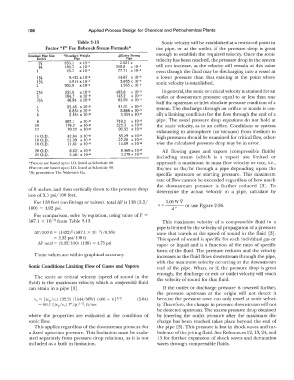
                                 Table 2-13                          Sonic velocity will be established at a restricted point in
                    Factor "F'' For Babcock Steam Formula*         the  pipe,  or  at  the  outlet,  if the  pressure  drop  is  great
             Nominal Pipe Size   *Standard Weight   #Extra Strong   enough  to establish  the required velocity.  Once the sonic
                Inches          Pipe                  Pipe        velocity has been reached, the pressure drop in the system
                 V2         955.1   x  10- 3       2.051  x
                 %          184.7   x  J0-3       340.8   x  I 0-3   will  not increase,  as  the velocity will  remain at this value
                 l           45.7   x  10-3        77.71  x  10- 3   even though  the fluid may  be discharging into a vessel at
                 l v..        9.432 x  10- 3       14.67  x  10- 3   a  lower  pressure  than  that  existing  at  the  point where
                 IY2          3.914 x  10- 3       5.865 x  10-s   sonic velocity is established.
                2           951.9   x  J0-6         1.365 x  10- 3
                2V2         351.0   x  10- 6      493.8   x  10-6    In general, the sonic or critical velocity is attained for an
                 3          104.7   x  J0-6       143.2   x  10-6   outlet or downstream  pressure  equal  to  or less  than  one
                 3V2         46.94  x  J0-6        62.95  x  10- 6   half the upstream or inlet absolute pressure condition of a
                4            23.46  x J0-6         31.01  x  10- 6   system. The discharge through  an orifice or nozzle is usu-
                5             6.854 x  10- 6       8.866 x  10-6
                 6            2.544 x  10- 6        3.354 x  10- 6   ally a limiting condition for the flow  through  the end of a
                 8          587.1   x  10-9       748.2   x  10·-9   pipe.  The  usual  pressure  drop  equations  do  not hold at
                10           176.3   x 10- 9      225.3   x  J0-9   the  sonic  velocity,  as  in an  orifice.  Conditions  or systems
                12           70.32  x (0-9         90.52  x  10- 0   exhausting  to  atmosphere  (or vacuum)  from  medium  to
                140.D.       42.84  x  10- 9       55.29  x  J0-9   high pressures should be examined for critical flow,  other-
                160.D.       21.39  x 10-9         27.28  x  J0-9
                180.D.        11.61  x  10- 9      14.69  x  J0-9   wise the calculated pressure drop may be in error.
                200.D.        6.621  x  10-u        8.469 x  10- 9   All  flowing  gases  and  vapors  (compressible  fluids)
                240.D.        2.561  x  10- 9       3.278  x  10- 9
                                                                   including  steam  (which  is  a  vapor)  are  limited  or
             *Factors are based upon  1.0. listed as Schedule 40.   approach  a  maximum  in mass flow velocity  or rate,  i.e.,
             #Factors are based upon I.D. listed as Schedule 80.   lbs/sec  or lbs/hr  through  a  pipe  depending  upon  the
             tBy permission The Walworth Co.
                                                                   specific  upstream  or starting  pressure.  This  maximum
                                                                   rate of  flow cannot be exceeded regardless of how much
                                                                   the  downstream  pressure  is  further  reduced  [3].  To
             of  8 inches, and then vertically down to the pressure drop   determine  the  actual  velocity  in  a  pipe,  calculate  by
             loss of 3.5 psi/100 feet.
               For 138 feet (no fittings or valves), total .1P is 138  (3.5/   3.06W V
             100)  =  4.82 psi.                                    v  =   d  2   or use Figure 2-34.
               For comparison,  solve  by  equation, using value of F  =
             587.l X  10- 9  from Table 2-13.                        This  maximum  velocity  of a  compressible  fluid  in  a
                                                                   pipe is limited by the velocity of  propagation of a pressure
               LlP/100 ft=  (1432) (587.1  x  10- )/0.364          wave  that travels  at  the  speed  of sound  in the  fluid  [3].
                                          9
                               2
                        =  3.32 psi/  I 00 ft                      This speed of sound is specific for each individual  gas or
                 LlP  total= (3.32/100)  (138)  =  4.75  psi
                                                                   vapor or  liquid  and  is  a function  of the ratio of specific
                                                                   heats of the fluid.  The pressure  reduces and  the velocity
               These values are within graphical accuracy.         increases as the fluid flows downstream  through the pipe,
                                                                   with the maximum velocity occurring al the downstream
             Sonic Conditions limiting Flow of Gases and Vapors    end  of the pipe.  When,  or if,  the  pressure  drop  is great
                                                                   enough, the discharge or exit or outlet velocity will reach
               The  sonic  or critical  velocity  (speed  of sound  in  the
             fluid)  is  the  maximum  velocity which  a  compressible fluid   the velocity of sound for that fluid.
             can attain in a pipe  [3].                              If the  outlet or discharge  pressure  is  lowered  further,
                                                                   the  pressure  upstream  at  the  origin  will  not  detect  it
               v,  =  [ ( cp/  c.)  (32.2)  (1544/MW)  ( 460 +  t) ]112   (2-84)   because  the pressure wave  can only  travel  al sonic veloci-
                 =  68.1  [(cp/cv)  P'/p] 112,  ft/sec             ty.  Therefore, the change in pressure downstream will not
                                                                   be detected upstream. The excess pressure drop obtained
             where  the  properties  are  evaluated  at  the  condition  of   by  lowering  the  outlet pressure  after  the  maximum  dis-
             sonic flow.                                           charge  has  been  reached  takes  place  beyond  the  end of
               This  applies regardless of the downstream pressure for   the  pipe  [3]. This pressure is lost in shock waves and tur-
             a fixed upstream pressure.  This limitation must be evalu-   bulence of the  jetting fluid. See References 12, 13, 24, and
             ated separately from  pressure  drop  relations,  as  it is  not   15 for further expansion  of shock waves  and detonation
             included as a built in limitation.                    waves  through compressible fluids.

