


Page 244 - APPLIED PROCESS DESIGN FOR CHEMICAL AND PETROCHEMICAL PLANTS, Volume 1, 3rd Edition
P. 244
214                       Applied Process Design for Chemical and Petrochemical  Plants

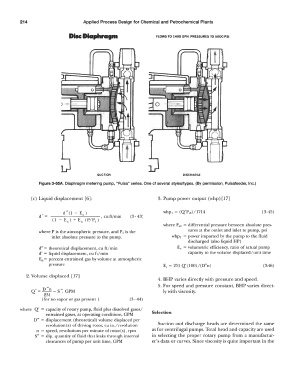
                             DIM Diaphragm                       FLOWS TO  1480 GPH,  PRESSURES TO 5000 PSI


                                         SUCTION                            DISCHARGE
                 Figure 3-65A.  Diaphragm metering pump,  "Pulsa" series.  One of several styles/types.  (By permission,  Pulsafeeder,  Inc.)


              (c)  Liquid displacement [6]:                       3.  Pump power output (whp) [ 17]


                           d "(1  -  En)                            whp,  =  (Q'P,ct)/1714                   (3-45)
                 d'=  ----------, cu ft/min            (3-43;
                       (1  -  E 11)   +  E,,  (P/P 1)
                                                                    where P,d  =  differential  pressure between  absolute pres-
                 where P  is theatmospheric  pressure,  and P 1  is the       sures at the outlet and inlet to  pump, psi
                      inlet absolute pressure to the pump.              whp,  =  power imparted by the pump to the fluid
                                                                              discharged  (also liquid HP)
                 d"= theoretical displacement,  cu ft/min                 Ev  =  volumetric efficiency,  ratio of actual  pump
                 d' =  liquid displacement,  cu ft/min                        capacity to the volume displaced/unit time
                 En=  percent entrained gas by volume at atmospheric
                     pressure                                       E,.  =  231  Q'(lOO)/(D"n)               (3-46)

            2.  Volume displaced  [ 17]
                                                                  4.  BHP varies directly with  pressure and speed.
                                                                  5.  For speed and pressure constant,  BHP varies direct-
              Q'  =  D "n  - S"  GPM                                ly with viscosity.
                   231     '
                  (for no vapor or gas present  )     (3- 44)

         where  Q'  =  capacity of rotary pump, fluid plus dissolved gases/   Selection
                    entrained gases,  at operating conditions, GPM
               D"  =  displacement (theoretical)  volume displaced per
                    revolution (s)  of  driving rotor,  cu in./revolution   Suction and discharge  heads are determined  the same
                n  =  speed, revolutions per minute of rotor(s), rpm   as for centrifugal pumps. Total head and capacity are used
               S"  =  slip,  quantity of fluid  that leaks  through internal   in  selecting  the  proper rotary  pump  from  a  manufactur-
                    clearances of pump per unit time, GPM       er's data or curves.  Since viscosity is quite important in the

