


Page 243 - APPLIED PROCESS DESIGN FOR CHEMICAL AND PETROCHEMICAL PLANTS, Volume 1, 3rd Edition
P. 243
Pumping of Liquids                                      213

           required submergence. If the water is al l00°F at sea level,   used for metering.  For specific  performance  characteris-
           approximateiy  17 inches  must  be  added to  the  70°F sub-   tics of any type consult the  appropriate  manufacturer.
           mergence value  [14].
                                                                   These  pumps are low in cost,  require  small  space,  and
                                                                are self priming.
                             Rotary Pumps
                                                                   Some  can  be  rotated  in  either  direction,  have  close
                                                                clearances, require over-pressure  relief protection on dis-
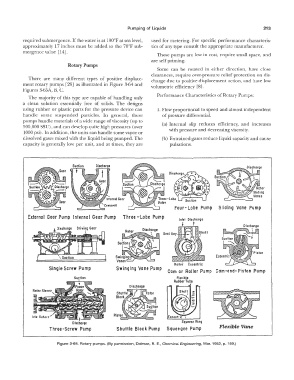
             There  are  many  different  types  of positive  displace-   charge due to positive displacement action, and have low
           ment rotary pumps  [29]  as illustrated in Figure  3-64 and   volumetric efficiency  [8].
           Figures 3-65A, B,  C.
                                                                   Performance Characteristics of  Rotary Pumps:
             The  majority of this type  are  capable of handling only
           a  clean  solution  essentially  free  of solids.  The  designs
           using  rubber or plastic  parts  for the pressure  device can   1. Flow proportional to speed and almost independent
           handle  some  suspended  particles.  In  general,  these   of pressure differential.
           pumps handle materials of a wide range of  viscosity (up to
           500,000 SSU), and can develop quite high pressures  ( over   (a)  Internal  slip  reduces  efficiency,  and  increases
           1000 psi). In addition, the units can handle some vapor or   with pressure and decreasing viscosity.
           dissolved gases mixed with the liquid being pumped. The   (b)  Entrained gases reduce liquid capacity and cause
           capacity  is  generally  low  per unit,  and at times,  they  are   pulsations.


                               Suction


                                                                          Four-Lobe  Pump    Sliding  Vane  Pump
             External  Gear Pump  Internal  Gear Pump   Three -Lobe  Pump   Inlet  Discharge
                                                                             i    t                    Discharge
                                 Drivi;g  Gear                                                fil__�,0/-�  I  I


               ��


                      Single Screw  Pu mp         Swinging  Vane Pump
                                                                       Com  or  Roller Pump  Cam-and-Piston  Pump
                                Su�tion                                    Flexible
                                                                          Rubber Tu�e


                                 ·,  t
                               Discharge
                      Three-Screw  Pump           Shuttle  Block Pump   Squeegee  Pump       Flexible Vane


                         Figure 3-64.  Rotary pumps.  (By permission,  Dolman,  R.  E.,  Chemical Engineering,  Mar.  1952,  p.  159.)

