


Page 288 - APPLIED PROCESS DESIGN FOR CHEMICAL AND PETROCHEMICAL PLANTS, Volume 1, 3rd Edition
P. 288
258                       Applied Process Design for Chemical  and Petrochemical  Plants

            EMULSION  OF  PRODUCT   INLET          OUTLET           3.  Note  that some units use  pipe line size for the sepa-
              WATER  &  SOLIDS   COALESCING
                                 MEDIA
                                                                       rator size designation, others  do not.
                                                                    4.  From the system operating pressure, establish the pres-
                                                                       sure rating designation for the separator selection.
                                                                    5.  Note that most separators for pressure system opera-
            REMOVABLE
              HEAD                                                     tions are fabricated according to  the ASME code.
                                                                    6.  Specify  special  features  and  materials  of construc-
                                                                       tion, such as alloy or nonferrous impingement parts,
                                     WATER                             or entire vessel  if affected by process vapor and liq-
                                   ACCUMULATOR
                 SWING  BOLTS   DRAIN   5UMP                           uid.  Specify  special liquid reservoir at base  of unit if
                                                                       necessary for system operations.  Line units  normally
                                                                       have  dump  traps  or liquid  outlet of separator,  while
                                                                       vessel type often use some type ofliquid level control.
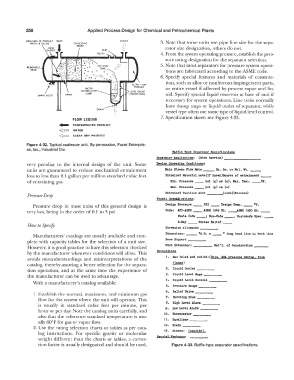
                                                                     7.  Specification sheet:  see Figure  4-33.
                                FLOW  LEGEND
                          �  CONTAMINATED  PRODUCT
                          �'-:--.-;,i   WATER
                          ¢=:J   CLEAN  DRY  PRODUCT
            Figure 4-32. Typical  coalescer unit.  By permission,  Facet Enterpris-
            es,  Inc.,  Industrial  Div.
                                                                         Bartle  :r,pe  Separator Spec1r1cationa
                                                                   Separator .lppl1cat1on1   (Give  Sarrtce)  --------
            very  peculiar  lo  the  internal  design  of the  unit.  Some   Dea1gn  Operating  Conditions:
            units  are  guaranteed  to  reduce  mechanical  entrainment   Maln  Stream  l"lov  Rate  __  Sp.  Gr.  or Mol.  Wt.  __
            loss to less than 0.1  gallon per million standard cubic feet   Entrained  Material rate(U Jmovn)Source  or entra1111111ent __
            of entraining gas.                                           Min.  Preaaure  __ psi  (g)  or  (a), Jlax.  Temp,  __  or.
                                                                         Max.  Pressure  __ pe1  (g)  or  (a)
                                                                       Entrained  Particle  a1ze   (meah)(H1crona)
             Pressure Drop
                                                                   Veaael 3pectr1cat1ona:
               Pressure  drop  in most units  of this  general  design  is   Dea1gn  Preaaure  __ PSI  __ Dea1gn  Temp.  __  or.
            very low,  being in  the order of 0.1  to 3 psi.           Coile:  .lPI-.1.SME  --  .lBIIE  1949  Ed.  __  .I.SHE  1950  m.  --
                                                                            State  Code  __  ;  Hon-Code  __  ,  Cuatomei's  Spec.  __
                                                                            X-Ra7  __  Stress  Rel1et'  __
             How to Specify
                                                                       Corrosion allovande  ----
                                                                       D1mena1ons:  __  •o.D.  x  __ •  long  bend  line  to  bend  llne
               Manufacturers' catalogs  are  usually  available and com-
             plete with  capacity  tables  for the  selection  of a unit size.   Baae  SUpport ----
             However,  it is good practice lo have this selection checked   H1at  Ex.tractor:   ,  Mat'l.  ot Conatructlon   _
             by  the manufacturer whenever conditions will allow.  This   Connect1ona
             avoids  misunderstandings  and  misinterpretations  of the   1.  Gae  inlet and  outlet:(S1ze,  .I.SA.  pressure  rat1ne;,  tuie
             catalog,  thereby assuring a better selection for the separa-   rlanp;e)
             tion  operation,  and  at the  same  time  the  experience  of   2.  Uqu1d  outiet ----
             the manufacturer can be used to  advantage.               3.  Uquld  Level aage  ----
               With a manufacturer's catalog available:                4.  Uquid  Level Control ----
                                                                       5.  Pressure  Gsuge  ----
                                                                       6.  Reller Valve  ----
               1. Establish  the normal,  maximum,  and minimum gas
                 flow for the system where the unit will operate.  This   7.  Bursting  Dlac  ----
                 is  usually  in  standard  cubic  feet  per  minute,  per   8.  High  Level Alarm----
                 hour or per day.  Note the catalog units  carefully,  and   9.  Low  Level Alarm  ----
                 also  that the reference standard  temperature is usu-   10.  Thermometer ----
                 ally 60°F for gas or vapor flow.                     11.  F.qual1zer ----
               2.  Use  the  rating selection charts or tables as  per cata-   12.  Drain ----
                                                                      13.  Others:  ( apeei:l'Y)
                 log  instructions.  For  specific  gravity  or  molecular
                 weight different than  the charts  or tables,  a  correc-   6pec1a1  Features:
                 tion factor is usually designated and should be used.   Figure 4-33.  Baffle-type separator specifications.

