


Page 40 - APPLIED PROCESS DESIGN FOR CHEMICAL AND PETROCHEMICAL PLANTS, Volume 1, 3rd Edition
P. 40
Process Planning, Scheduling and  Flowsheet Design                     25

            C-2       Single compressor in different service  (by   incineration, vent,  and cooling  tower waters  and number
                      fluid or compression ratio)  from C.-1 's above.   all like process items within that system, for example:
            S-1       First separator in a process                 Reactor System, R:  Reactor is RD-1
            S-2       Second separator in a process                                 Reactor vent cooler is RE-1
            S-3a      Two identical separators connected in                         Reactor vent condenser is RE-2
            S-3b      parallel, in same process service.                            Reactor recycle pump is RP-1
                                                                                    Level control valve is RLC-1
                                                                                    Relief valve is RSV- l
             Some  equipment  code  systems  number  all  items  on   Then,  establish  the  same  concept for all other unit or
           first process  flowsheet with  100 series, as  C-101, C-102, P-   block  processing  systems.  This  is  often  helpful  for  large
           l 06 to represent ccmpressors number 101  and 102 in dif-   projects, such as refinery or grass roots chemical processes.
           ferent services  and pump  106 as  the  sixth  pump  on  the   Valve  identification  codes  are  usually  used  in  prefer-
           sheet.  The second sheet uses the 200 series,  etc. This has   ence  to placing each valve specification on the flowsheet.
           some  engineering  convenience  but  is  not  always  clear   This latter method is feasible for small systems, and is most
           from the process view.                               workable when a given manufacturer (not  necessarily  the
                                                                 same manufacturer for all  valves)  can be selected and his
             To  keep  process  continuity  clear,  it  is  usually  best  to
           number all like items sequentially throughout the process,   valve  catalog  figure  number  used  on  the  flowsheet,  For
           with no concern for which flowsheet they appear on. Also,   large jobs,  or where  many  projects  arc in progress  at one
           another popular numbering arrangement is  to  identify  a   time, it is common practice to establish valve specifications
           system  such  as  reaction,  drying,  separation,  purification,   for the various process and utility services  (see Figures 1-25
                                                                 and  1-26)  by  manufacturers'  catalog  figure  numbers.
                                                                These  are  coded  as  V-11, V-12,  V-13,  etc.,  and such  code
                                                                 numbers are used on the flowsheets wherever these valves
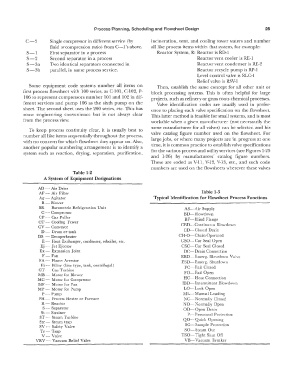
                                Table  1-2
                   A System of Equipment Designations

                 AD --  Air Drier
                 AF -  Air  Filter                                                   Table  1-3
                  Ag -  Agitator                                  Typical Identification for Flowsheet Process Functions
                   B-  Blower
                 BR -  Barometric  Refrigeration  Unit                         AS-Air Supply
                   C -  Compressor                                            BD-Blowdown
                 CP -  Car Puller
                 CT -- Cooling  Tower                                          BF-Blind  Flange
                 CV -  Conveyor                                              CED-Continuous  Blowdown
                  D -  Drum or tank                                           CD-Closed  Drain
                 DS  -  Desuperheater                                       CH-0-Chain Operated
                   E -  Heat Exchanger,  condenser,  reboiler,  etc.         CSO-  Car Seal  Open
                  Ej -  Jet Ejector                                          CSC-Car Seal Closed
                  Ex -  Expansion  Joint                                      DC-Drain Connection
                   F-Fan                                                     EBD-Emerg.  Blowdown  Valve
                  FA -  Flame  Arrestor                                      ESD-Emerg.  Shutdown
                  Fi -  Filter  ( line  type,  tank,  centrifugal)
                 GT-  Gas  Turbine                                             FC-- Fail  Closed
                 MB -  Motor for Blower                                       FO-  Fail  Open
                 MC -  Motor for Compressor                                   HC-Hose  Connection
                 MF -  Motor for Fan                                          IBD-  Intermittent Blowdown
                 MP --  Motor for Pump                                        LO-  Lock  Open
                   P--  Pump                                                  ML-Manual Loading
                 PH -  Process  Heater or Furnace                             NC-Normally  Closed
                  R-  Reactor                                                 NO-Normally  Open
                   S -  Separator                                             OD-Open Drain
                  St -  Strainer
                  ST -  Steam  Tu: bine                                         P-  Personnel  Protection
                  Str -- Stearn  trap                                         QO-Quick  Opening
                  SV ---  Salety  Valve                                        SC-Sample  Protection
                  Tr-Trap                                                      SO-Steam  Out
                   V-  Valve                                                 TSO-Tight Shut Off
                VRV -  Vacuum Relief Valve                                    VB-Vacuum  Breaker

