


Page 428 - APPLIED PROCESS DESIGN FOR CHEMICAL AND PETROCHEMICAL PLANTS, Volume 1, 3rd Edition
P. 428
394                      Applied  Process  Design for Chemical  and  Petrochemical  Plants


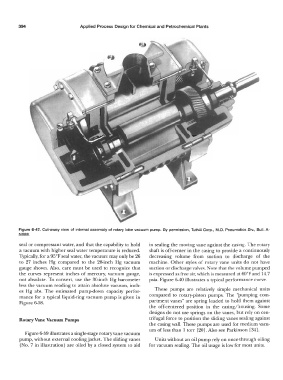
         Figure 6-47.  Cut-away view of internal  assembly of rotary  lobe vacuum  pump.  By  permission,  Tuthill  Corp.,  M.D.  Pneumatics  Div.,  Bull.  A-
         5/888.
         seal or compressant water,  and that the capability to  hold   in sealing the moving vane against the casing.  The rotary
         a vacuum with  higher seal  water temperature  is reduced.   shaft is off-center in the casing to  provide a continuously
         Typically,  for a 95°F seal water,  the vacuum may only be 26   decreasing  volume  from  suction  to  discharge  of  the
         to  27  inches  Hg  compared  to  the  28-inch  Hg  vacuum   machine.  Other  styles  of rotary  vane  units  do  not  have
         gauge  shown.  Also,  care  must be  used  to  recognize  that   suction or discharge valves. Note that the volume pumped
         the  curves  represent  inches  of mercury,  vacuum  gauge,   is expressed as free air, which is measured at 60°F and 14.7
         not absolute.  To  convert,  use  the  30-inch  Hg  barometer   psia.  Figure 6-40 illustrates a  typical performance curve.
         less  the vacuum  reading to attain absolute vacuum,  inch-
         es  Hg  abs.  The  estimated  pump-down  capacity  perfor-   These  pumps  are  relatively  simple  mechanical  units
         mance for a  typical  liquid-ring vacuum  pump is  given  in   compared  to  rotary-piston  pumps.  The  "pumping  com-
         Figure 6-38.                                          partment vanes" are  spring  loaded  to  hold  them  against
                                                               the  off-centered  position  in  the  casing/housing.  Some
                                                               designs do not use springs  on  the vanes,  but rely  on cen-
         Rotary Vane Vacuum Pumps                              trifugal force to  position  the sliding vanes sealing against
                                                               the casing wall. These pumps are  used for medium vacu-
                                                               um ofless  than  I  torr [20]. Also see Parkinson  [34].
           Figure 6-39 illustrates a single-stage rotary vane vacuum
         pump, without external cooling jacket.  The sliding vanes   Units without an oil pump rely on once-through oiling
         (No.  7  in  illustration)  are oiled by  a  closed  system  to aid   for vacuum sealing.  The oil  usage is low for most units.

