


Page 431 - APPLIED PROCESS DESIGN FOR CHEMICAL AND PETROCHEMICAL PLANTS, Volume 1, 3rd Edition
P. 431
Ejectors and Mechanical Vacuum Systems                            397


                                                                     hL  =  Liquid height,  ft
                                                                      K  =  Non-condensable load factor
                                                                      L  =  Latent heat of vaporization of steam, BTU/lb
                                                                      M  = Average mol weight of system vapors
                                                                     M, =  Molecular weight of non-condensable gas
                                                                     M,  = Molecular weight of conclensable vapor
                                                                      P  = Total absolute pressure,  lbs/sq in. absolute  (or
                                                                          other consistent units), or system operating pres-
                                                                          sure,  torr
                                                                      Pa= Partial  pressure of air in mixture,  lbs/sq in. abs
                                                                      Pc  = Absolute intake pressure of pump
                                                                     Pct  =  Piston displacement,  cu ft/min
                                                                     P  n  =  Partial  pressure of non-conclensable gas;  pounds
                                                                          per square inch absolute  (or other absolute units)
                                                                      P,  =  Static pressure, atm
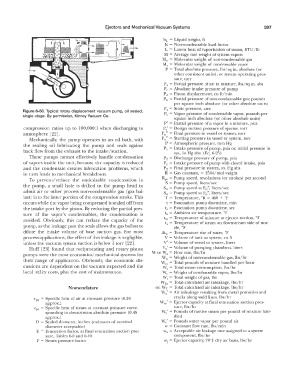
           Figure 6-50.  Typical  rotary displacement vacuum  pump,  oil  sealed,   P,,  = Vapor pressure of condensable vapor,  pounds per
           single-stage.  By permission,  Kinney Vacuum Co.
                                                                          square inch absolute  (or other absolute units)
                                                                      P' =  Partial  pressure of a vapor in a mixture,  psia
           compression.  ratios  up  to  100,000:1  when  discharging  to   P,' =  Design suction pressure of ejector,  torr
           atmosphere  [22].                                         P  n"  =  Final pressure in vessel or system, torr
             Mechanically,  the  pump  operates  in  an  oil  bath,  with   P  0"   =  Starting pressure in vessel or system, torr
           the  seaiing  oil  lubricating  the  pump  and  seals  against   P  =  Atmospheric pressure, mm Hg
           back flow from the exhaust to  the intake/suction.         P 1  =  Intake pressure of pump, psia or,  initial  pressure in
                                                                          sys., in Hg abs.  (Eq.  6-25)
             These  pumps  cannot effectively  handle  condensation   P 2  =  Discharge pressure of pump, psia
           of vapors  inside  the unit,  because  the capacity is reduced   Pc= Intake  pressure of pump with closed intake,  psia
           and the  condensate  creates  lubrication  problems,  which   P 2  =  Final  pressure in system,  in.  Hg abs
           in turn leads to mechanical breakdown.                     R  =  Gas constant,  =  1544/mol weight
             To  prevent/reduce  the  undesirable  condensation  in   Rp,  =  Pump speed, revolutions  ( or strokes)  per second
                                                                      S  =  Pump speed,  liters/sec
           the  pump,  a  small  hole  is  drilled  in  the  pump  head  to   S 11  =  Pump speed at P  n",  liters/sec
           admit air or other process  non-condensable gas  (gas  bal-   S 0  =  Pump speed at Po",  liters/sec
           last)  into the latter portion of the compression stroke. This   T  = Temperature,  R  =  460  +  °F
                                                                                     0
           occurs while the vapor being com  pressed is sealed off from   t =  Evacuation pump downtime, min
           the intake port by the piston. By reducing the partial pres-   t,  =  Evacuation pump downtime, sec
           sure  of  the  vapor's  condensables,  the  condensation  is   t,.  = Ambient air temperature,  °F
           avoided.  Obviously,  this  can  reduce  the  capacity  of the   tm  =  Temperature of mixture at ejector suction, °F
                                                                      t,  =  Temperature of steam on downstream side of noz-
           pump, as the leakage past the seals allows the gas ballast to   zle, °F
           dilute  the  intake  volume  of base  suction  gas.  For  most   Lltw  =  Temperature rise of water,  °F
           process applications, the effect of this leakage is negligible,   V  =  Volume of tank or system,  cu ft
           unless the vacuum system suction is below  1  torr [22].   V'  = Volume of vessel or system, liters
             Huff  [23]  found  that  reciprocating  and  rotary  piston   V 0'  = Volume of pumping chambers,  liters
           pumps were  the most economical  mechanical systems for   W or Wa  = Flow rate,  lbs/hr
                                                                     Wn  =  Weight of non-condensable gas, lbs/hr
           their range  of application.  Obviously,  the  economic  dis-   Wm  = Total pounds of mixture handled per hour
           cussions are dependent on the vacuum expected and the     vV,  = Total steam  consumption,  lbs/hr
           local utility costs,  plus the cost of maintenance.       '"-'v  = Weight of condensable vapor,  lbs/hr
                                                                     W,  = Total  weight of  gas,  lbs
                                                                    WTa  = Total  calculated air inleakage,  lbs/hr
                              N omenclature                       or,  WT  = Total calculated air inleakage, lbs/hr
                                                                    w; =  Air inleakage resulting from metal  porosities and
               Cpa  =  Specific heat of air at constant pressure  (0.24   cracks  along weld lines, lbs/hr
                    approx.)                                        Wm' =  Ejector capacity at final evacuation suction pres-
               cp,  =  Specific heat of steam at constant pressure corre-   sure,  lbs/hr
                    sponding to downstream absolute pressure  (0.45   w; =  Pounds of motive steam per pound of mixture han-
                    approx.)                                              dled
                D  = Sealed diameter,  inches  (estimates of nominal   Y.,T,,'  =  Pounds water vapor per pound air
                    diameter acceptable)                              w  =  Constant flow rate, lbs/min
                E  =  Evacuation factor,  at final evacuation suction pres-   w.  = Acceptable air leakage rate assigned  to a system
                    sure, Tables 6-9 and 6-10                             component,  lbs/hr
                F  =  Steam pressure factor                           wj  =  Ejector capacity,  70°F dry air basis,  lbs/hr

