


Page 434 - APPLIED PROCESS DESIGN FOR CHEMICAL AND PETROCHEMICAL PLANTS, Volume 1, 3rd Edition
P. 434
400                       Applied  Process Design for Chemical and Petrochemical  Plants

             pressure  relieving  devices  be  installed for pressure  relief   Types of Valves/Relief Devices
             and venting per codes  [1, 10,  13]  [33].
               Although not specifically recognized in the titles of the   There  are  many  design  features  and  styles  of safety
             codes,  the rupture  disk as a relieving device, is,  neverthe-   relief  valves, such as flanged ends, screwed ends, valves fit-
             less,  included  in  the  requirements  as  an  acceptable   ted internally for corrosive service,  high temperature ser-
             device.                                              vice,  cryogenic service/low temperatures,  with bonnet or
               Usual  practice  is  to use  the  terms  safety valve or relief   without,  nozzle  entrance  or  orifice  entrance,  and  resis-
             valve  to indicate a relieving valve for system overpressure,   tance  to  discharge  piping  strains  on  body.  Yet  most of
             and  this  will  be  generally  followed  here.  When  specific   these variations have little, if  anything to do with the actu-
             types  of  valves are significant,  they will be emphasized.   al  performance to relieve overpressure in a system/vessel.
                                                                     A few designs are important to the system arrangement
                                                                  and relief performance:
                  Types of Positive Pressure Relieving Devices
                 (see manufacturers' catalogs for design details)
                                                                   Conventional Safety Relief Valve
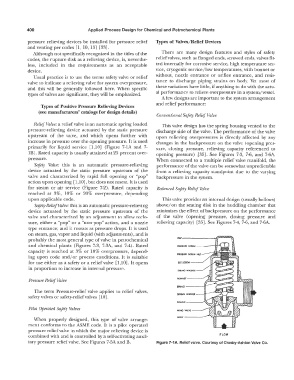
               Relief Valve: a relief  valve is an automatic spring loaded   This valve  design has the spring housing vented to the
             pressure-relieving  device  actuated  by  the  static  pressure   discharge side of the valve. The performance of the valve
             upstream  of  the  valve,  and  which  opens  further  with   upon  relieving  overpressures  is  directly  affected  by  any
             increase in pressure over the opening pressure. It is used   changes in the back  pressure  on  the valve  ( opening pres-
             primarily  for  liquid  service  [1,10]  (Figure  7-lA  and  7-   sure,  closing  pressure,  relieving  capacity  referenced  to
             lB). Rated capacity is usually attained at 25 percent over-   opening  pressure)  [35].  See  Figures  7-3,  7-6,  and  7-6A.
             pressure.                                            When connected  to  a  multiple relief valve  manifold,  the
               Safety  Valve:  this  is  an  automatic  pressure-relieving   performance of the valve can be somewhat unpredictable
             device  actuated  by  the  static  pressure  upstream  of the   from  a  relieving  capacity  standpoint due  to  the  varying
             valve  and  characterized  by  rapid  full  opening  or  "pop"   backpressure in the system.
             action upon opening  [l,10], but does not reseat. It is used
             for  steam  or  air  service  (Figure  7-2).  Rated  capacity  is   Balanced Safety Relief  Valve
             reached  at  3%,  10%  or  20%  overpressure,  depending
             upon applicable code.                                   This valve provides an internal design  (usually bellows)
               Safety-Relief  Valve:  this is an automatic pressure-relieving   above/on  the  seating disk in  the huddling chamber that
             device  actuated  by  the  static  pressure  upstream  of the   minimizes the effect of backpressure on the performance
             valve  and characterized  by  an  adjustment to  allow  reclo-   of  the  valve  (opening  pressure,  closing  pressure  and
             sure,  either a  "pop" or a  "non-pop"  action,  and a nozzle   relieving capacity)  [35]. See Figures  7-4,  7-6,  and 7-6A.
             type  entrance;  and it reseats as  pressure drops.  It is used
             on steam, gas, vapor and liquid  (with adjustments), and is
             probably  the most general  type of valve in petrochemical
             and chemical  plants  (Figures  7-3,  7-3A,  and  7-4).  Rated
             capacity  is  reached at 3%  or 10%  overpressure,  depend-
             ing upon  code  and/or  process  conditions.  It is  suitable
             for use either as  a safety or a relief valve  [1,10]. It opens
             in proportion  to increase in internal  pressure.

             Pressure Relief Valve

               The  term  Pressure-relief valve  applies  to  relief valves,
             safety valves or safety-relief  valves  [10].

             Piwt  Operated Safety  Valves

               When  properly  designed,  this  type  of valve  arrange-
             ment conforms  to  the ASME  code.  It is  a  pilot operated
             pressure relief  valve in which the major relieving device is
             combined with and is controlled by a self-activating auxil-                     FLOW
             iary pressure  relief  valve.  See Figures 7-5A and B.   Figure 7-1A.  Relief valve.  Courtesy of Crosby-Ashton Valve Co.

