


Page 440 - APPLIED PROCESS DESIGN FOR CHEMICAL AND PETROCHEMICAL PLANTS, Volume 1, 3rd Edition
P. 440
406                      Applied Process Design for Chemical  and Petrochemical  Plants


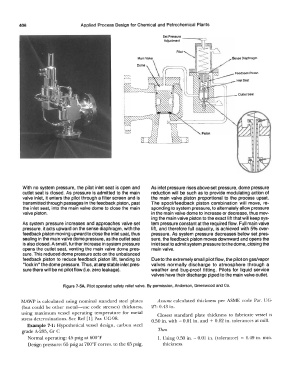
          With  no system  pressure,  the pilot inlet seat is open and   As inlet pressure rises above set pressure, dome pressure
          outlet seat is closed. As pressure is admitted to the main   reduction will be such as to provide modulating action of
          valve inlet,  it enters the pilot through a filter screen and is   the  main  valve  piston  proportional  to  the  process  upset.
          transmitted through passages in the feedback piston, past   The  spool/feedback  piston  combination  will  move,  re-
          the inlet seat,  into the main valve dome to close the main   sponding to system pressure, to alternately allow pressure
          valve piston.                                         in the main valve dome to increase or decrease, thus mov-
                                                                ing the main valve piston to the exact lift that will keep sys-
          As system  pressure  increases and approaches valve set   tem pressure constant at the required flow. Full main valve
          pressure, it acts upward on the sense diaphragm, with the   lift,  and therefore full capacity,  is achieved with 5% over-
          feedback piston moving upward to close the inlet ssat, thus   pressure.  As system pressure decreases below set pres-
          sealing in the main valve dome pressure, as the outlet seat   sure, the feedback piston moves downward and opens the
          is also closed. A small, further increase in system pressure   inlet seat to admit system pressure to the dome, closing the
          opens the outlet seat,  venting the main valve dome pres-   main valve.
          sure. This reduced dome pressure acts on the unbalanced
          feedback piston  to reduce feedback piston  lift, tending to   Due to the extremely small pilot flow, the pilot on gas/vapor
           "lock in" the dome pressure. Thus, at any stable inlet pres-   valves  normally  discharge  to  atmosphere  through  a
           sure there will be no pilot flow (i.e. zero leakage).   weather and  bug-proof fitting.  Pilots  for liquid  service
                                                                valves have their discharge piped to the main valve outlet.

                           Figure 7-5A.  Pilot operated safety relief valve.  By permission, Anderson,  Greenwood and Co.


          MAWP  is  calculated  using  nominal  standard  steel  plates   Assume calculated  thickness  per ASME  code  Par.  UG-
          (but could be other metal-use code stresses)  thickness,   27:  0.43 in.
          using  maximum  vessel  operating  temperature  for metal   Closest  standard  plate  thickness  to  fabricate  vessel  is
          stress determinations.  See Ref [l]  Par.  UG-98.     0.50 in. with - 0.01  in. and +  0.02  in.  tolerances at mill.
            Example  7-l:  Hypothetical  vessel  design,  carbon  steel
          grade A-285, Gr C                                       Then
            Normal  operating:  45 psig at 600°F                  1.  Using  0.50 in.  - 0.01  in.  (tolerance)  =  0.49 in.  min.
             Design pressure:  65 psig at 700°F corres.  to the 65 psig.   thickness.

