


Page 445 - APPLIED PROCESS DESIGN FOR CHEMICAL AND PETROCHEMICAL PLANTS, Volume 1, 3rd Edition
P. 445
Process Safety and Pressure-Relieving Devices                       411


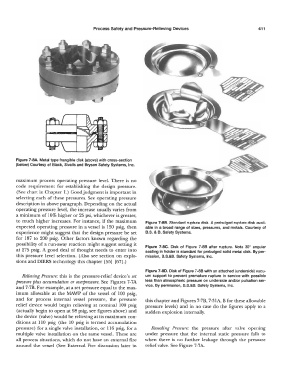
        Figure 7-BA.  Metal type frangible disk (above)  with cross-section
        (below)  Courtesy of Black,  Sivalls and Bryson Safety Systems,  Inc.


        maximum  process  operating pressure  level.  There  is  no
        code  requirement  for  establishing  the  design  pressure.
        (See chart in Chapter 1.)  Good judgment is important in
        selecting each of these  pressures.  See  operating pressure
        description in above paragraph. Depending on the actual
        operating pressure  level,  the increase  usually varies  from
        a minimum of 10% higher or 25 psi, whichever is greater,
        to  much  higher increases.  For instance,  if the  maximum   Figure 7-88. Standard  rupture disk.  A prebulged rupture disk avail-
        expected operating pressure  in a vessel  is  150  psig,  then   able  in  a  broad  range of sizes,  pressures,  and  metals.  Courtesy  of
        experience might suggest that the design  pressure  be set   B.S. & B. Safety Systems.
        for  187  to  200  psig.  Other factors  known  regarding  the
        possibility of a  run-away  reaction  might suggest setting it   Figure  7-BC.  Disk  of  Figure  7-88  after  rupture.  Note  30°  angular
        at 275  psig.  A good deal  of thought needs  to  enter  into   seating in holder is standard for prebulged solid metal disk.  By per-
        this  pressure  level  selection.  (Also  see  section  on  explo-   mission,  B.S.&B.  Safety Systems,  Inc.
        sions and DIERS technology this chapter [55]  [67] .)
                                                             Figure 7-BD.  Disk of Figure 7-88 with an attached (underside) vacu-
          Relieving Pressure:  this  is  the  pressure-relief device's  set   um  support to  prevent  premature  rupture  in  service with  possible
        pressure plus  accumulation  or  overpressure.  See  Figures  7-7A   less than  atmospheric pressure  on underside and/or pulsation  ser-
        and 7-7B. For example, at a set pressure equal to the max-   vice.  By permission,  B.S.&B.  Safety Systems,  Inc.
        imum  allowable  at the  MAWP  of the  vessel  of 100  psig,
        and  for  process  internal  vessel  pressure,  the  pressure   this chapter and Figures 7-7B, 7-31A, B for these allowable
        relief device  would  begin  relieving  at  nominal  l 00  psig   pressure  levels)  and in  no case do the  figures  apply  to  a
        (actually begin to open at 98 psig, see figures above)  and   sudden explosion internally.
        the device  (valve) would be relieving at its maximum con-
        ditions  at  110  psig  (the  10  psig  is  termed  accumulation
        pressure)  for a single valve  installation,  or 116 psig,  for a   Resealing  Pressure:  the  pressure  after  valve  opening
        multiple  valve  installation  on  the  same vessel.  These  are   under  pressure  that  the  internal  static  pressure  falls  to
        all  process  situations, which do  not have an  external  fire   when  there  is  no  further  leakage  through  the  pressure
        around  the  vessel  (See  External  Fire  discussion  later  in   relief valve.  See Figure 7-7A.

