


Page 442 - APPLIED PROCESS DESIGN FOR CHEMICAL AND PETROCHEMICAL PLANTS, Volume 1, 3rd Edition
P. 442
408                      Applied Process Design for Chemical and Petrochemical  Plants


                                                                                           Opening  Presssure
            ....   100                             100                                100
            Q)
            ::,
            (J)   80                                80                                 80   Closing  Pressure
            (J)
            ....
            Q)
            o,
            Q)
            Cl)
            ......
            0
            '#
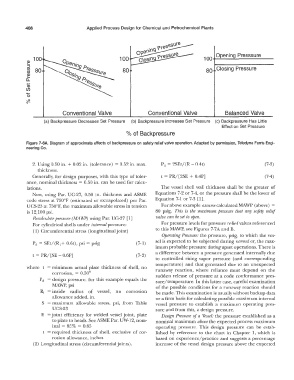
                           Conventional  Valve                 Conventional  Valve             Balanced Valve
                   (a)  Backpressure  Decreases  Set Pressure   (b)  Backpressure Increases Set Pressure  (c)  Backpressure  Has Little
                                                                                              Effect on  Set Pressure
                                                      % of Backpressure

            Figure 7-6A.  Diagram of approximate effects of backpressure on safety relief valve operation. Adapted by pennission, Teledyne Farris Engi-
            neering Co.


               2.  Using 0.50 in.  +  0.02 in.  (tolerance)  = 0.52 in.  max.   P  d  =  2SEt/  (R - 0.4t)      (7-3)
                 thickness.
               Generally,  for design  purposes,  with  this  type  of toler-   t = PR/[2SE  +  0.4P]           (7-4)
            ance,  nominal  thickness  =  0.50 in.  can be used for calcu-
            lations.                                                The  vessel  shell  wall  thickness  shall  be  the  greater of
               Now,  using  Par.  UG-27,  0.50  in.  thickness  and ASME   Equations 7-2 or 7-4,  or the pressure shall be the lower of
            code  stress  at 750°F  (estimated or extrapolated)  per Par.   Equation 7-1  or 7-3  [l].
            UCS-23 at 750°F,  the maximum allowable stress in tension   For above example assume calculated MAWP  (above)  =
            is 12,100 psi.                                        80  psig.  This  is  the  maximum  pressure  that  any  safety  relief
               Recalculate pressure  (MAivP)  using Par.  UG-27  [l]   valve can be set  to  open.
               For cylindrical  shells under internal pressure:     For pressure levels for pressure relief  valves referenced
               ( 1) Circumferential  stress  (longitudinal joint)   to  this MAWP,  see Figures 7-7A and B.
                                                                    Operating Pressure:  the  pressure,  psig,  to which  the ves-
                                                                  sel is expected to be subjected during  normal or,  the max-
               Pc1  =  SEt/(R;+  0.6t), psi= psig         (7-1)
                                                                  imum probable pressure during upset operations. There is
                                                                  a difference between a  pressure generated internally due
               t  = PR/  [SE - 0.6P]                      (7-2)
                                                                  to  controlled  rising  vapor pressure  (and  corresponding
                                                                  temperature)  and  that generated  due  to  an  unexpected
            where  t  = minimum  actual  plate  thickness  of shell,  no   runaway  reaction,  where  reliance  must  depend  on  the
                       corrosion,  =  0.50"                       sudden  release  of pressure  at a  code  conformance  pres-
                  P  d  = design  pressure,  for this  example equals  the   sure/  temperature.  In this latter case, careful examination
                       !vIAWP,  psi                               of the possible  conditions for a  runaway reaction  should
                  R,  = inside  radius  of  vessel,  no  corrosion   be made. This examination is usually without backup data
                       allowance added, in.                       or a firm basis for calculating possible maximum internal
                  S  = maximum  allowable  stress,  psi,  from  Table   vessel  pressure  to  establish  a  maximum  operating  pres-
                       UCS-23                                     sure and from this,  a design pressure.
                  E  = joint efficiency  for welded  vessel  joint,  plate   Design Pressure  of  a  Vessel:  the  pressure  established  as a
                       to plate to heads.  See ASME Par.  UW-12, nom-   nominal  maximum above the expected process  maximum
                       inal  =  85%  =  0.85                      operating  pressure.  This  design  pressure  can  be  estab-
                   t  = required  thickness  of shell,  exclusive  of cor-   lished  by  reference  to  the  chart  in  Chapter  1,  which  is
                       rosion allowance,  inches                  based on experience/practice and suggests  a  percentage
               (2)  Longitudinal  stress  (circumferentialjoints).   increase of the vessel design pressure above  the expected

