


Page 495 - APPLIED PROCESS DESIGN FOR CHEMICAL AND PETROCHEMICAL PLANTS, Volume 1, 3rd Edition
P. 495
Process Safety and  Pressure-Relieving Devices                       461

                               Table 7-10                        Q. =  required flow,  cu ft/min at standard conditions of I 4.7
                                continued                            psia and 6Q°F,  SCFM

           Example                                                 Actual flowing conditions, ACFM
           'What is  rupture pressure at 500CF of a  nickel disk rated 300  psi
           at 72cF?
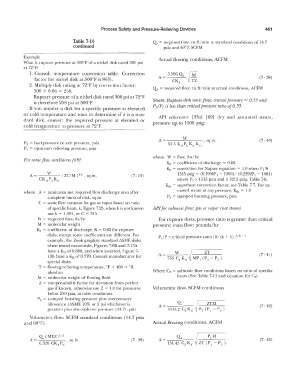
             1. Consult  temperature  conversion  table.  Correction   5.596 Q,   'M
                                                                                I-
               factor for nickel disk at 500°F is 86%.             A=    CKd   "   V  TZ                     (7 - 39)
             2. Multiply disk rating at 72°F by correction factor:
               300  x  0.86  =  258.                             C2.A  = required flow,  cu ft/min at actual  conditions, ACFM
               Rupture pressure of a nickel disk rated 300 psi at 72°F
               is therefore  258 psi  at 500°F.                  Stearn:  Rupture disk sonic flow;  critical pressure  =  0.55 and
             If you require  a disk for a specific  pressure  at elevated   P 2/P 1  is less  than critical pressure  ratio of  0.55.
           or cold temperature  and want to  determine if it is  a stan-   API  reference  [33a]  [69]  dry  and  saturated  steam,
           dard  disk,  convert  the  required  pressure  at  elevated  or   pressure up to  1500 psig:
           cold temperature to pressure at 72°F.

                                                                             w           .
                                                                   A =  _  •          ,  sq m.               (7 - 40)
           P2  =  backpressure or exit pressure, psia                  si.s s , Pb  Kn  K,h
           P 1  =  upsu·eam relieving pressure,  psia
                                                                 where  W  =  flow,  lbs/hr
           For sonic  flow conditions  [69):
                                                                       K.:i  =  coefficient of discharge  = 0.62.
                                                                       K,,  =  correction for Napier equation  =  1.0 when P 1  �
                                                        (7-10)             1515 psig =  (0.1906P1  - 1000)/ (0.2292P1  - 1061)
                                                                           where  P1  >  1515 psia and S  3215 psia,  Table 7-6.
                                                                      K. 11  =  superheat correction factor,  see Table 7-7.  For sat-
           where  A =  minimum net required flow discharge area after      urated steam al any pressure, Rs1,  =  1.0
                     complete burst of disk,  sq  in.                  Pb  =  stamped bursting pressure, psia
                 C  =  sonic flow constant for gas or vapor based on ratio
                     of specific heats,  k,  Figure 7-25, when k is not known   AP!  for subsonic flow: gas or vapor (not steam)
                     use k  =  1.001, or C  =  315
                 W  =  required flow,  lb/hr                       For rupture disks, pressure ratio is greater than critical
                 M  =  molecular weight                          pressure;  mass flow:  pounds/hr
                 K.:i  =  coefficient of discharge, K =  0.62  for rupture
                     disks,  except some coefficients are different.  For   PjP > critical pressure ratio  [2/(k  t  l)Jk/k -  1
                     example, the Zook graphite  standard ASME disks
                     when tested mono-style, Figures 7-9B and 7-13A
                     have a K0 of 0.888,  and when inverted, Figure 7-
                     l 3B have a K0 of 0. 779.  Consult manufacturer for                                     ( 7 - 41)
                     special  disks.
                                                       0
                 T  =  flowing relieving temperature,  °F +  460  =  R
                     absolute                                    Where C2  =  subsonic flow conditions based on  ratio of specific
                 M  =  molecular weight of flowing fluid                   heats  (See Table 7-11  and equation  for C 2)
                 Z  =  compressibility factor for deviation from perfect
                     gas  if known, otherwise use Z  =  1 .0 for pressures   Volumetric flow,  SCFM conditions
                     below 250 psia, at inlet conditions.
                 Pb  =  stamped bursting pressure  plus overpressure
                     allowance  (ASME  l 0%  or 3  psi whichever is                                          (7 - 42)
                     greater)  plus atmospheric pressure  ( 14. 7), psi a
             Volumetric flow:  SCFM standard conditions  (14.7 psia
           and 60°F)                                             Actual  flowing conditions, ACFM


                 Q,  (MTZ) 112   .
             A=             -,  so  111.                (7- 38)                                              (7- 43)
                 6.326  CKd Pb   '

