


Page 493 - APPLIED PROCESS DESIGN FOR CHEMICAL AND PETROCHEMICAL PLANTS, Volume 1, 3rd Edition
P. 493
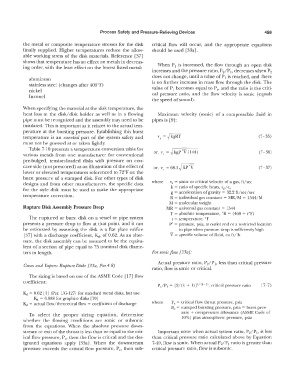
Process Safety and  Pressure-Relieving  Devices                     459

           the metal  or composite  temperature  stresses for the  disk   critical  flow  will  occur,  and  the  appropriate  equations
           finally  supplied.  Higher  temperatures  reduce  the  allow-   should be used  [33a].
           able working stress  of the disk  materials.  Reference  [37]
           shows that temperature has an effect on metals in decreas-
           ing order,  with  the least effect on the lowest listed metal:   When  P 1  is  increased,  the  flow  through  an  open  disk
                                                                 increases and the pressure ratio, P 2/P 1, decreases when P2
                                                                 does not change,  until a value of P 1  is reached, and there
             aluminum
             stainless steel  ( changes after 400°F)             is no further increase  in mass  flow  through  the disk.  The
                                                                                           O
             nickel                                             value of P1  becomes equal  to P and the ratio is  the criti-
             Inconel                                             cal  pressure  ratio,  and  the  flow  velocity  is  sonic  (equals
                                                                 the speed of sound).

           When specifying the material at the disk temperature, the
           heat loss  at  the  disk/  disk  holder as  well  as  in  a  flowing   Maximum  velocity  (sonic)  of a  compressible  fluid  in
           pipe must be recognized and the assembly may need to be   pipes is  [9]:
           insulated.  This is important as it relates to the actual tem-
           perature  at the  bursting pressure.  Establishing  this  burst
           temperature  is  an  essential part  of the  system  safety  and                                  (7- 35)
           must not be guessed at or taken lightly.
             Table 7-10 presents  a  temperature conversion table for   �
           various  metals  from  one  manufacturer for conventional   or, v,  =  kgP 'V ( 14  4)            (7- 36)
           pre-bulged,  tension-loaded  disks  with  pressure  on  con-
           cave side (not prescored)  as an illustration of the effect of   or, v,  = 68.1  � KP'V           (7 - 37)
           lower or elevated temperatures referenced to 72°F on the
           burst pressure  of a  stamped  disk.  For other types  of disk
           designs  and from  other manufacturers,  the  specific  data   where   v,  =  sonic or critical velocity of a gas,  ft/  sec
           for the  style  disk  must be  used  to  make  the  appropriate   k  =  ratio of specific heats,  cp/  c,
                                                                        g  =  acceleration of gravity= 32.2 ft/sec/sec
           temperature correction.                                      R  =  individual gas constant =  MR/M  =  1544/M
                                                                        M  =  molecular weight
           Rupture Disk Assembly Pressure Drop                        MR= universal gas constant= 1544
                                                                        T = absolute temperature,  R  =  (460 +  r'F)
                                                                                              0
             The  ruptured  or burst disk  on  a  vessel  or pipe  system   t  =  temperature,  °F
           presents  a pressure  drop to flow at that point,  and it can   P'  =  pressure,  psia,  at outlet end or a restricted location
           be  estimated  by  assuming  the  disk  is  a  flat plate  orifice   in pipe when  pressure drop is sufficiently high
           [37]  with a  discharge coefficient,  Kci,  of 0.62.  As an alter-   V  =  specific volume of fluid, cu ft/lb
           nate,  the disk assembly  can  be assumed to  be  the equiva-
           lent of a section of pipe equal  to  75  nominal  disk diame-
           ters in  length.                                     For sonic floio  [33a]:

                                                                   Actual  pressure  ratio,  P 2 /P 1,  less  than critical pressure
           Gases arid  Vapors:  Rupture Disks  [33a,  Par.4.8]
                                                                 ratio, flow is sonic or critical.
             The sizing is based on use of the ASME Code  [ 17]  flow
           coefficient:
                                                                   Pc/P1  =  [2/(k +  l)]kl(k-l), critical  pressure  ratio   (7-7)
           K.J  =  0.62  [11  (Par.  UG-127)  for standard metal  disks,  but use
               K.J  =  0.888 for graphite  disks  [70]
           K.J  =  actual flow/theoretical flow  =  coefficient of discharge   where   Pc  =  critical  flow throat pressure, psi a
                                                                         Pb= st.amped bursting pressure,  psia  =  burst pres-
                                                                             sure  + overpressure allowance  (ASME Code of
             To  select  the  proper  sizing  equation,  determine
           whether  the  flowing  conditions  are  sonic  or  subsonic       10%)  plus atmospheric pressu,-e,  psia
           from  the  equations.  When  the  absolute  pressure  down-
           stream or exit of the throat is less than or equal to the crit-   Important note: when actual  system ratio,  P2/P1, is less
           ical flow pressure, P then the flow is critical and the des-   than  critical  pressure  ratio  calculated  above  by  Equation
                            O
           ignated  equations  apply  [33a].  When  the  downstream   7-4.0, flow is sonic. When actual P 2 /P 1  ratio is greater than
           pressure  exceeds  the critical  flow  pressure,  Pc,  then  sub-   critical  pressure  ratio,  flow is subsonic.

