


Page 541 - APPLIED PROCESS DESIGN FOR CHEMICAL AND PETROCHEMICAL PLANTS, Volume 1, 3rd Edition
P. 541
Applied Process Design                                     507

           where  R is either 9.0 or 10.0 and T;  is  the  operating  tem-            Table 7-27
           perature in C.                                           Fuel Characteristic Constant for  Venting Equation

           5-3.3.3 For vessels  fabricated of low carbon steel and low   Fuel               C(psi)112       C(kPa)1;2
           alloy stainless steel Fu  =  4.0 and  FY  =  2.0.     Anhydrous Ammonia            0.05            0.13
                                                                 Methane                      0.14            0.37
           5-3.4 The presence of any pressure relief  device on the sys-   Gases with fundamental
           tem shall not cause the design pressure calculated by 5-3.3   burning velocity less than
           to be reduced.                                          1.3 times that of propane   0.17           0.45
                                                                 St-I dusts                   0.10            0.26
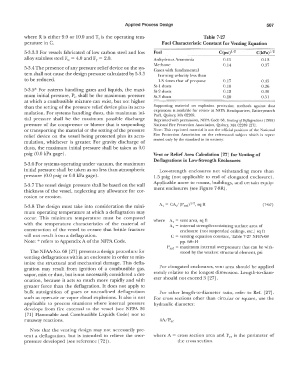
           5-3.5*  For systems  handling gases  and liquids,  the  maxi-   St-2 dusts         0.12            0.30
           mum  initial  pressure,  Pi,  shall  be  the maximum  pressure   St-3 dusts        0.20            0.51
           at which a combustible mixture can exist,  but not higher
           than the setting of the pressure relief device plus its accu-   Supporting  material  on  explosion  protection  methods  against  dust
           mulation.  For systems  handling dusts,  this  maximum  ini-   explosions  is  available  for review  at NFPA  Headquarters,  Baueryrnarch
                                                                 Park, Quincy,  wlA 02269.
           tial  pressure  shall  be  the  maximum  possible  discharge   Reprinted with permission, NFPA Code 68,  Venting of  Deflagrations  (1988)
           pressure  of the  compressor or blower that is  suspending   National  Fire Protection Association,  Quincy,  c\llA 02269  [27).
           or transporting the material or the setting of the pressure   Note: This  reprinted material is not the official  position  of the National
           relief device  on  the vessel  being  protected  plus its  accu-   Fire  Protection Association  on  the  referenced  subject which  is  repre-
           mulation,  whichever  is  greater.  For  gravity  discharge  of   sented only by  the standard in its entirety,
           dusts,  the maximum  initial  pressure shall be taken as  0.0
           psig  (0.0 kPa gage).                                 Vent or Relief Area Calculation [27]  for Venting of
                                                                 Deflagrations in Low-Strength Enclosures
           5-3.6 For systems operating under vacuum, the maximum
           initial  pressure shall be taken as no less than atmospheric   Low-strength  enclosures  not  withstanding  more  than
           pressure  (0.0 psig or 0.0 kPa gage).                 l.5  psig  (not applicable  to  end of elongated  enclosure).

           5-3. 7 The vessel design pressure shall be based on the wall   Applicable  more  to  rooms,  buildings,  and certain  equip-
           thickness  of the vessel,  neglecting any  allowance for cor-   ment enclosures  ( see Figure  7-8R).
           rosion or erosion.

                                                                                 1
           5-3.8 The  design  must  take  into  consideration  the mini-   A, =  CA,/  (P 10 ct)  1 2,   sq ft   (7-67)
           mum operating temperature at which a deflagration may
           occur.  This  minimum  temperature  must  be  compared   where  A.v  =  vent area,  sq  ft
           with  the  temperature  characteristics  of  the  material  of   A,= internal  strength-containing surface area of
           construction  of the vessel  to  ensure  that brittle  fracture   enclosure  (not suspended  ceilings,  etc.)  sq ft
           will  not result from a deflagration.                        C  = venting equation constant, Table 7-27 NFPA-68
           Note:  * refers  to Appendix A of the NFPA Code.                 pp.  68-14
                                                                       P,cct  =  maximum internal overpressure  that can be with-
              The NFAA.-l\o. 68  [27)  presents a design procedure for      stood by the weakest structural element,  psi
           venting deflagrat.ions within an enclosure in order to min-
           imize  the  structural  and mechanical  damage.  This  defla-
           gration  may  result  from  ignition  of a  combustible  gas,   For elongated enclosures, vent area should be applied
           vapor,  mist or dust, but is not necessarily considered a det-   evenly relative  to  the longest dimension.  Length-to-diam-
           onation,  because  it acts  so  much  more  rapidly  and with   eter should not exceed 3  [27].
           greater force  than  the  deflagration.  It does  not apply  to
           bulk  autoignition  of gases  or  unconfined  deflagrations   For other  length-to-diameter  ratio,  refer to  Ref.  [27].
           such as  open-air or vapor cloud  explosions.  It also  is  not   For cross  sections  other than  circular or square,  use  the
           applicable  to  process  situations  where  internal  pressure   hydraulic diameter:
           develops  from  fire  external  to  the  vessel  (see  NFPA  30
           [71]  Flammable  and Combustible  Liquids  Code)  nor to
           runaway reactions.
              Note  that the  venting design  may  not necessarily  pre-
           vent a  deflagration,  but  is  intended  to  relieve  the  over-   where A  =  cross  section  area and Per  is  the  perimeter of
           pressure deveioped  (see reference  [72]).                      the cross section.

