


Page 537 - APPLIED PROCESS DESIGN FOR CHEMICAL AND PETROCHEMICAL PLANTS, Volume 1, 3rd Edition
P. 537
Applied Process Design                                    503


                              Blast Scaling                        When accounting for effective charge weight at ground
                                                                 reflection  the conversion is  [ 49]:
             The  Universal  Hopkinson-Cranz  and  Sachs  Laws  of
           Blast  Scaling  have  both  been  verified  by  experiment.                                        (7-63)
           These  laws  state  that  self-similar  blast  (shock)  waves  are
           produced at identical  scaled distances when two explosive   We  =  effective charge weight in pounds of Tl\'T for estimating
           charges  of similar geometry and  the same  explosive  com-   surface burst effects with free air.
           position,  but of different size,  are  detonated  in  the same
           atmosphere  [ 49].                                      It is  assumed  that the  energy  reieased  is  proportional
                                                                 to  the mass of a specific explosive  [ 40].
             The scaled distance Z, which is a  proportionately con-
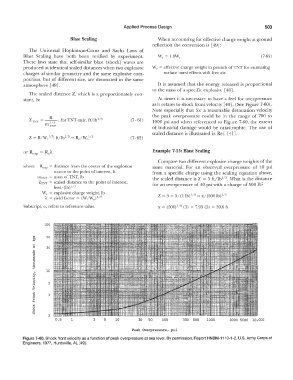
           stant,  is:                                             At times it is necessary  to  have a feei  for overpressure
                                                                 as it relates to shock front  velocity  [ 49]. (See Figure 7-60).
                                                                 Note  especially  that for a  reasonable  detonation velocity
                                                                 the  peak  overpressure  could  be  in  the  range  of 700  to
             Z 1.'11.  =--R-, forTNToniy,  fl/lb 113    (7 - 61)   1000  psi  and when  referenced  to  Figure  7-60,  the extent
                      1/3
               .
                    IT!Tl\"T
                                                                 of industrial  damage  would  be  catastrophic.  The  use  of
                                                                 scaled distance is illustrated in Ref.  [ 41].
                                                        (7-62)
           or Rexp  =  RoA                                       Example 7-15: Blast Scaling
                                                                   Compare two different explosive charge weights of the
           where  R,xp  =  distance from  the center of the explosion   same  material.  For  an  observed  overpressure  of 40  psi
                       source to the point of interest,  ft      from  a  specific  charge  using  the  scaling  equation  above,
                 mTNT  =  mass of TNT,  lb                       the scaled distance is  Z  =  5 ft/lb 1  What is  the distance
                                                                                             1 3.
                 0NT  =  scaled distance to the point of interest,   for an overpressure  of 40 psi with a  charge of 500 lb?
                       feet/  (lb)  113
                   We  =  explosive charge weight,  lb                          1            1
                                          1 3
                    A  =  yield factor=  (W/V1 10)  1              Z  =  5  =  5/(l lb) 1 3   =  x/(500 lb) 1 3
           Subscript,  o, refers to reference value.               x  =  (500) i/s  (5)  =  7.93  (5)  =  39.6 ft


                    100

               "'
               ,fr   50
               ""'  o   30
               OJ
               "'  �
               Ul
               "
               0
               ii
                    10
                     5

                     3
               �
               o
               0
              .s::
               ,:/]
                     1
                        0.5    1        3   5    10        30   so   100     300  500   1000     3000  5000  10,000
                                                        Peak Overpressure,  psi
           Figure 7-60. Shock front velocity as a function of peak overpressure at sea level.  By permission,  Report HNDM-1110-1-2,  U.S.  Army Corps of
           Engineers,  1977,  Huntsville, AL (49].

