


Page 164 - Basic Japanese
P. 164
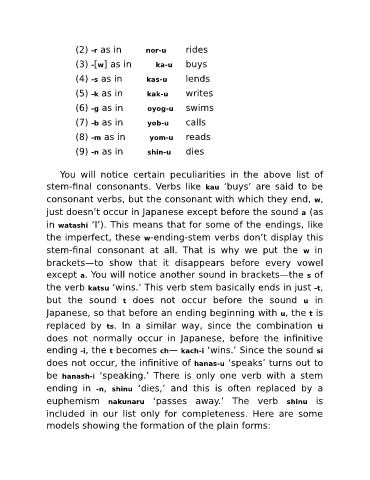
(2) -r as in           nor-u        rides

                          (3) -[w] as in             ka-u     buys

                          (4) -s as in            kas-u       lends

                          (5) -k as in            kak-u       writes

                          (6) -g as in            oyog-u      swims

                          (7) -b as in            yob-u       calls

                          (8) -m as in             yom-u      reads

                          (9) -n as in            shin-u      dies


                     You  will  notice  certain  peculiarities  in  the  above  list  of
                stem-final  consonants.  Verbs  like  kau  ‘buys’  are  said  to  be

                consonant verbs, but the consonant with which they end, w,

                just doesn’t occur in Japanese except before the sound a (as
                in watashi ‘I’). This means that for some of the endings, like

                the imperfect, these w-ending-stem verbs don’t display this
                stem-final  consonant  at  all.  That  is  why  we  put  the  w  in

                brackets—to  show  that  it  disappears  before  every  vowel

                except a. You will notice another sound in brackets—the s of
                the verb katsu ‘wins.’ This verb stem basically ends in just -t,

                but  the  sound  t  does  not  occur  before  the  sound  u  in
                Japanese, so that before an ending beginning with u, the t is

                replaced  by  ts.  In  a  similar  way,  since  the  combination  ti

                does  not  normally  occur  in  Japanese,  before  the  infinitive

                ending -i, the t becomes ch— kach-i ‘wins.’ Since the sound si
                does not occur, the infinitive of hanas-u ‘speaks’ turns out to
                be  hanash-i  ‘speaking.’  There  is  only  one  verb  with  a  stem

                ending  in  -n,  shinu  ‘dies,’  and  this  is  often  replaced  by  a

                euphemism  nakunaru  ‘passes  away.’  The  verb  shinu  is
                included  in  our  list  only  for  completeness.  Here  are  some

                models showing the formation of the plain forms:

