


Page 167 - Basic Japanese
P. 167
the  same  form,  which  is  tabe.  This  means  that  taberu  is  a

                vowel  verb.  Do  the  same  for  kaeru  and  kaerimasu  ‘returns.’
                After removing -ru and -masu, you get kae and kaeri, which are

                different.  This  means  that  kaeru  ‘returns’  is  a  consonant

                verb. No need to be alert all the time. You just need to be
                alert if you see a verb that ends in -eru or -iru. The following

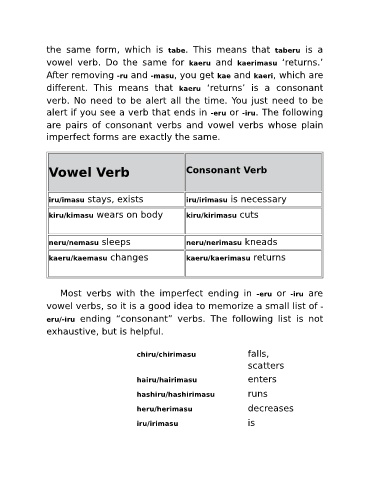
                are  pairs  of  consonant  verbs  and  vowel  verbs  whose  plain
                imperfect forms are exactly the same.


                 Vowel Verb                                    Consonant Verb


                 iru/imasu stays, exists                       iru/irimasu is necessary

                 kiru/kimasu wears on body                     kiru/kirimasu cuts


                 neru/nemasu sleeps                            neru/nerimasu kneads

                 kaeru/kaemasu changes                         kaeru/kaerimasu returns


                     Most  verbs  with  the  imperfect  ending  in  -eru  or  -iru  are

                vowel verbs, so it is a good idea to memorize a small list of -

                eru/-iru  ending  “consonant”  verbs.  The  following  list  is  not
                exhaustive, but is helpful.


                                              chiru/chirimasu                      falls,
                                                                                   scatters


                                              hairu/hairimasu                      enters
                                              hashiru/hashirimasu                  runs


                                              heru/herimasu                        decreases
                                              iru/irimasu                          is

