


Page 169 - Basic Japanese
P. 169
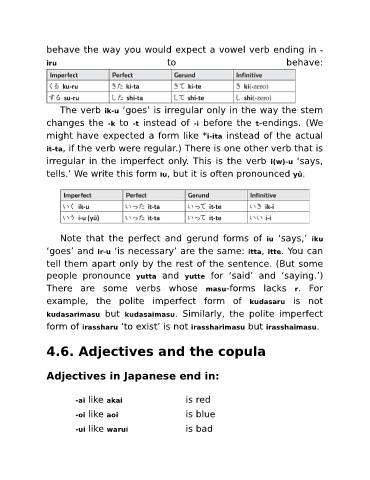
behave the way you would expect a vowel verb ending in -
                iru                                     to                                      behave:


                     The verb ik-u ‘goes’ is irregular only in the way the stem
                changes the  -k to  -t instead of  -i before  the  t-endings.  (We

                might have expected a form like *i-ita instead of the actual

                it-ta, if the verb were regular.) There is one other verb that is
                irregular in the imperfect only. This is the verb  i(w)-u ‘says,

                tells.’ We write this form iu, but it is often pronounced yū.


                     Note  that  the  perfect  and  gerund  forms  of  iu  ‘says,’  iku

                ‘goes’ and ir-u ‘is necessary’ are the same: itta, itte. You can
                tell them apart only by the rest of the sentence. (But some

                people  pronounce  yutta  and  yutte  for  ‘said’  and  ‘saying.’)
                There  are  some  verbs  whose  masu-forms  lacks  r.  For

                example,  the  polite  imperfect  form  of  kudasaru  is  not

                kudasarimasu  but  kudasaimasu.  Similarly,  the  polite  imperfect
                form of irassharu ‘to exist’ is not irassharimasu but irasshaimasu.


                4.6. Adjectives and the copula


                Adjectives in Japanese end in:


                          -ai like akai                       is red

                          -oi like aoi                        is blue

                          -ui like warui                      is bad

