


Page 189 - Basic Japanese
P. 189
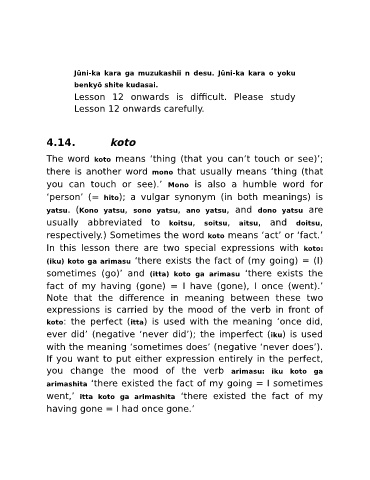
Jūni-ka  kara  ga  muzukashii  n  desu.  Jūni-ka  kara  o  yoku

                          benkyō shite kudasai.
                          Lesson  12  onwards  is  difficult.  Please  study
                          Lesson 12 onwards carefully.


                4.14.                koto


                The word  koto means ‘thing (that you can’t touch or see)’;
                there is another word  mono that usually means ‘thing (that

                you  can  touch  or  see).’  Mono  is  also  a  humble  word  for

                ‘person’  (=  hito);  a  vulgar  synonym  (in  both  meanings)  is
                yatsu.  (Kono  yatsu,  sono  yatsu,  ano  yatsu,  and  dono  yatsu  are

                usually  abbreviated  to  koitsu,  soitsu,  aitsu,  and  doitsu,
                respectively.) Sometimes the word koto means ‘act’ or ‘fact.’

                In  this  lesson  there  are  two  special  expressions  with  koto:

                (iku) koto ga arimasu ‘there exists the fact of (my going) = (I)
                sometimes  (go)’  and  (itta)  koto  ga  arimasu  ‘there  exists  the

                fact  of  my  having  (gone)  =  I  have  (gone),  I  once  (went).’
                Note  that  the  difference  in  meaning  between  these  two

                expressions  is  carried  by  the  mood  of  the  verb  in  front  of
                koto:  the  perfect  (itta)  is  used  with  the  meaning  ‘once  did,

                ever did’ (negative ‘never did’); the imperfect (iku) is used
                with the meaning ‘sometimes does’ (negative ‘never does’).

                If you want to put either expression entirely in the perfect,

                you  change  the  mood  of  the  verb  arimasu:  iku  koto  ga
                arimashita ‘there existed the fact of my going = I sometimes

                went,’  itta  koto  ga  arimashita  ‘there  existed  the  fact  of  my
                having gone = I had once gone.’

