


Page 241 - Basic Japanese
P. 241
Plain Affirmative         Plain Negative
                                        Meaning                  (Imperfect)            (Imperfect)


                 Vowel Verbs            eats                   tabe-ru               tabe-nai

                                        sees                   mi-ru                 mi-nai

                 Consonant              wins                   kats-u                kat-anai
                 Verbs                  rides                  nor-u                 nor-anai


                                        buys                   ka-u                  kaw-anai

                                        speaks                 hanas-u               hanas-anai

                                        writes                 kak-u                 kak-anai

                                        swims                  oyog-u                oyog-anai

                                        calls                  yob-u                 yob-anai

                                        reads                  yom-u                 yom-anai

                                        dies                   shin-u                shin-anai

                 Irregular              comes                  ku-ru                 ko-nai
                 Verbs                  does                   su-ru                 shi-nai


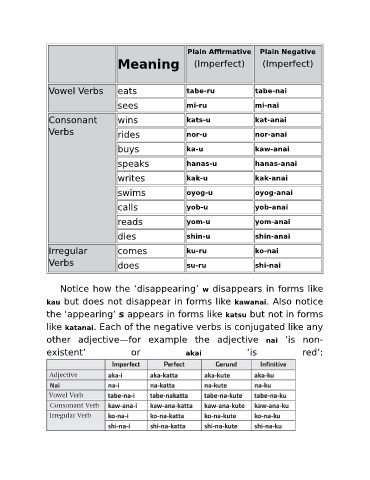
                     Notice how the ‘disappearing’ w disappears in forms like

                kau but does not disappear in forms like kawanai. Also notice

                the ‘appearing’ s appears in forms like katsu but not in forms
                like katanai. Each of the negative verbs is conjugated like any

                other  adjective—for  example  the  adjective  nai  ‘is  non-

                existent’                   or                akai                 ‘is               red’:

