


Page 244 - Basic Japanese
P. 244
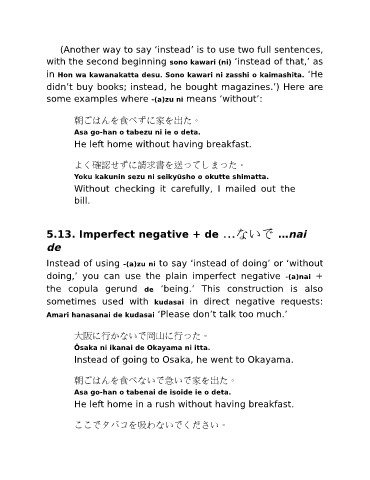
(Another way to say ‘instead’ is to use two full sentences,

                with the second beginning sono kawari (ni) ‘instead of that,’ as
                in Hon wa kawanakatta desu. Sono kawari ni zasshi o kaimashita. ‘He

                didn’t buy books; instead, he bought magazines.’) Here are
                some examples where -(a)zu ni means ‘without’:


                          朝ごはんを食べずに家を出た。
                          Asa go-han o tabezu ni ie o deta.

                          He left home without having breakfast.


                          よく確認せずに請求書を送ってしまった。

                          Yoku kakunin sezu ni seikyūsho o okutte shimatta.
                          Without  checking  it  carefully,  I  mailed  out  the
                          bill.


                5.13. Imperfect negative + de …ないで …nai

                de

                Instead of using -(a)zu ni to say ‘instead of doing’ or ‘without

                doing,’  you  can  use  the  plain  imperfect  negative  -(a)nai  +
                the  copula  gerund  de  ‘being.’  This  construction  is  also

                sometimes  used  with  kudasai  in  direct  negative  requests:

                Amari hanasanai de kudasai ‘Please don’t talk too much.’


                          大阪に行かないで岡山に行った。

                          Ōsaka ni ikanai de Okayama ni itta.
                          Instead of going to Osaka, he went to Okayama.


                          朝ごはんを食べないで急いで家を出た。
                          Asa go-han o tabenai de isoide ie o deta.
                          He left home in a rush without having breakfast.


                          ここでタバコを吸わないでください。

