


Page 243 - Basic Japanese
P. 243
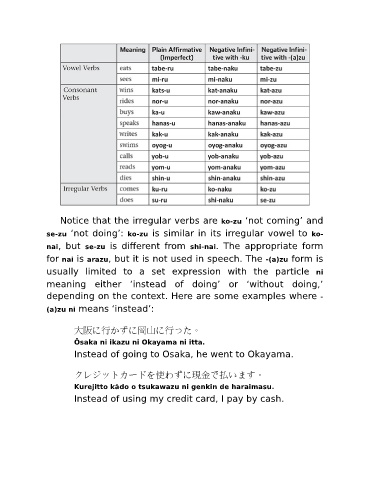
Notice that the irregular verbs are ko-zu ‘not coming’ and


                se-zu ‘not doing’:  ko-zu is similar in its irregular vowel to  ko-
                nai,  but  se-zu  is  different  from  shi-nai.  The  appropriate  form
                for nai is arazu, but it is not used in speech. The -(a)zu form is

                usually  limited  to  a  set  expression  with  the  particle  ni

                meaning  either  ‘instead  of  doing’  or  ‘without  doing,’
                depending on the context. Here are some examples where -

                (a)zu ni means ‘instead’:


                          大阪に行かずに岡山に行った。

                          Ōsaka ni ikazu ni Okayama ni itta.
                          Instead of going to Osaka, he went to Okayama.


                          クレジットカードを使わずに現金で払います。

                          Kurejitto kādo o tsukawazu ni genkin de haraimasu.
                          Instead of using my credit card, I pay by cash.

