


Page 158 - Jurnal Pendidikan Tingkatan Enam 2019 - Jilid 3
P. 158
Perubahan Paradigma Pemikiran Ke Arah Pendidikan Berkualiti

                                                                              LAMPIRAN  3
                                                                          LAMPIRAN  3

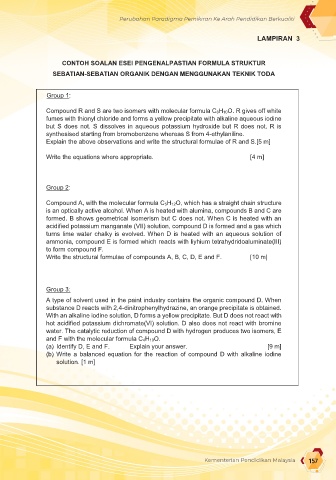
                    CONTOH SOALAN ESEI PENGENALPASTIAN FORMULA STRUKTUR
                 SEBATIAN-SEBATIAN ORGANIK DENGAN MENGGUNAKAN TEKNIK TODA

                     Group 1:

               Compound R and S are two isomers with molecular formula C8H10O. R gives off white
               fumes with thionyl chloride and forms a yellow precipitate with alkaline aqueous iodine
               but S does not. S dissolves in aqueous potassium hydroxide but R does not. R is
               synthesised starting from bromobenzene whereas S from 4-ethylaniline.
               Explain the above observations and write the structural formulae of R and S.[5 m]

               Write the equations where appropriate.                       [4 m]


               Group 2:

               Compound A, with the molecular formula C5H12O, which has a straight chain structure
               is an optically active alcohol. When A is heated with alumina, compounds B and C are
               formed. B shows geometrical isomerism but C does not. When C is heated with an
               acidified potassium manganate (VII) solution, compound D is formed and a gas which
               turns lime water chalky is evolved. When D is heated with an aqueous solution of
               ammonia, compound E is formed which reacts with liyhium tetrahydridoaluminate(III)
               to form compound F.
               Write the structural formulae of compounds A, B, C, D, E and F.     [10 m]


               Group 3:
               A type of solvent used in the paint industry contains the organic compound D. When
               substance D reacts with 2,4-dinitrophenylhydrazine, an orange precipitate is obtained.
               With an alkaline iodine solution, D forms a yellow precipitate. But D does not react with
               hot acidified potassium dichromate(VI) solution. D also does not react with bromine
               water. The catalytic reduction of compound D with hydrogen produces two isomers, E
               and F with the molecular formula C4H10O.
               (a) Identify D, E and F.    Explain your answer.                       [9 m]
               (b) Write a  balanced equation for the reaction of compound  D with  alkaline iodine
                  solution. [1 m]


                                                              Kementerian Pendidikan Malaysia  157

