


Page 523 - Python Data Science Handbook
P. 523
print(grid.best_params_)
                           print('accuracy =', grid.best_score_)
                   {'bandwidth': 7.0548023107186433}
                   accuracy = 0.966611018364


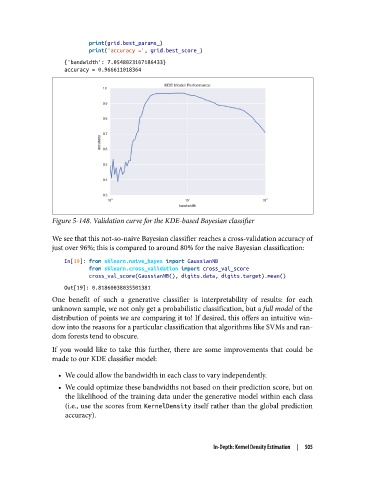
               Figure 5-148. Validation curve for the KDE-based Bayesian classifier

               We see that this not-so-naive Bayesian classifier reaches a cross-validation accuracy of
               just over 96%; this is compared to around 80% for the naive Bayesian classification:
                   In[19]: from sklearn.naive_bayes import GaussianNB
                           from sklearn.cross_validation import cross_val_score
                           cross_val_score(GaussianNB(), digits.data, digits.target).mean()
                   Out[19]: 0.81860038035501381
               One benefit of such a generative classifier is interpretability of results: for each
               unknown sample, we not only get a probabilistic classification, but a full model of the
               distribution of points we are comparing it to! If desired, this offers an intuitive win‐
               dow into the reasons for a particular classification that algorithms like SVMs and ran‐
               dom forests tend to obscure.
               If you would like to take this further, there are some improvements that could be
               made to our KDE classifier model:

                 • We could allow the bandwidth in each class to vary independently.
                 • We could optimize these bandwidths not based on their prediction score, but on
                   the likelihood of the training data under the generative model within each class
                   (i.e., use the scores from KernelDensity  itself rather than the global prediction
                   accuracy).


                                                            In-Depth: Kernel Density Estimation  |  505

