


Page 522 - Python Data Science Handbook
P. 522
Notice that each persistent result of the fit is stored with a trailing underscore (e.g.,
               self.logpriors_). This is a convention used in Scikit-Learn so that you can quickly
               scan the members of an estimator (using IPython’s tab completion) and see exactly
               which members are fit to training data.

               Finally, we have the logic for predicting labels on new data:
                       def predict_proba(self, X):
                           logprobs = np.vstack([model.score_samples(X)
                                                 for model in self.models_]).T
                           result = np.exp(logprobs + self.logpriors_)
                           return result / result.sum(1, keepdims=True)

                       def predict(self, X):
                           return self.classes_[np.argmax(self.predict_proba(X), 1)]
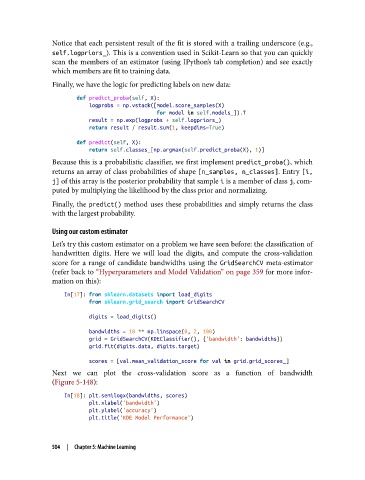
               Because this is a probabilistic classifier, we first implement predict_proba(), which
               returns an array of class probabilities of shape [n_samples, n_classes]. Entry [i,
               j] of this array is the posterior probability that sample i is a member of class j, com‐
               puted by multiplying the likelihood by the class prior and normalizing.
               Finally, the predict()  method uses these probabilities and simply returns the class
               with the largest probability.

               Using our custom estimator
               Let’s try this custom estimator on a problem we have seen before: the classification of
               handwritten digits. Here we will load the digits, and compute the cross-validation
               score for a range of candidate bandwidths using the GridSearchCV  meta-estimator
               (refer back to “Hyperparameters and Model Validation” on page 359 for more infor‐
               mation on this):
                   In[17]: from sklearn.datasets import load_digits
                           from sklearn.grid_search import GridSearchCV
                           digits = load_digits()
                           bandwidths = 10 ** np.linspace(0, 2, 100)
                           grid = GridSearchCV(KDEClassifier(), {'bandwidth': bandwidths})
                           grid.fit(digits.data, digits.target)

                           scores = [val.mean_validation_score for val in grid.grid_scores_]
               Next we can plot the cross-validation score as a function of bandwidth
               (Figure 5-148):

                   In[18]: plt.semilogx(bandwidths, scores)
                           plt.xlabel('bandwidth')
                           plt.ylabel('accuracy')
                           plt.title('KDE Model Performance')


               504  |  Chapter 5: Machine Learning

