


Page 126 - Template Tesis UTM v2.0
P. 126
4.2     Hybrid and Pure Samples


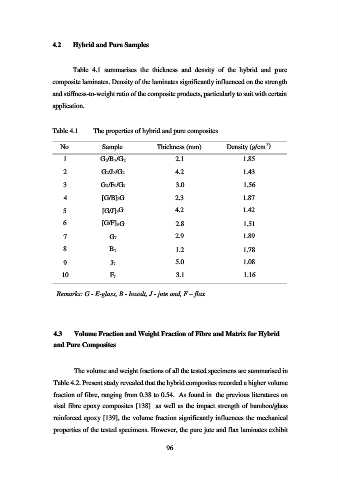
                           Table  4.1  summarises  the  thickness  and  density  of  the  hybrid  and  pure

                   composite laminates. Density of the laminates significantly influenced on the strength

                   and stiffness-to-weight ratio of the composite products, particularly to suit with certain
                   application.


                   Table 4.1      The properties of hybrid and pure composites

                                                                                              3
                      No             Sample             Thickness (mm)           Density (g/cm )
                       1            G2/B3/G2                  2.1                     1.85

                       2            G2/J3/G2                  4.2                     1.43

                       3            G2/F3/G2                  3.0                     1.56
                       4            [G/B]3G                   2.3                     1.87

                       5             [G/J]3G                  4.2                     1.42

                       6             [G/F]3G                  2.8                     1.51

                       7               G7                     2.9                     1.89

                       8               B7                     1.2                     1.78

                       9                J7                    5.0                     1.08

                      10               F7                     3.1                     1.16


                     Remarks: G - E-glass, B - basalt, J - jute and, F – flax


                   4.3     Volume Fraction and Weight Fraction of Fibre and Matrix for Hybrid

                   and Pure Composites


                           The volume and weight fractions of all the tested specimens are summarised in

                   Table 4.2. Present study revealed that the hybrid composites recorded a higher volume

                   fraction of fibre, ranging from 0.38 to 0.54.  As found in  the previous literatures on
                   sisal fibre epoxy composites [138]  as well as the impact strength of bamboo/glass

                   reinforced epoxy [139], the volume fraction significantly influences the mechanical

                   properties of the tested specimens. However, the pure jute and flax laminates exhibit

                                                           96

