


Page 133 - Template Tesis UTM v2.0
P. 133
300
                                         S2   G2/J3/G2
                         250             S5   [G/J]3G

                                         S7      G7
                                         S9   J7
                        Tensile strength (MPa)  150
                         200


                         100

                          50


                           0
                             0             0.004           0.008           0.012           0.016
                                                          Tensile strain


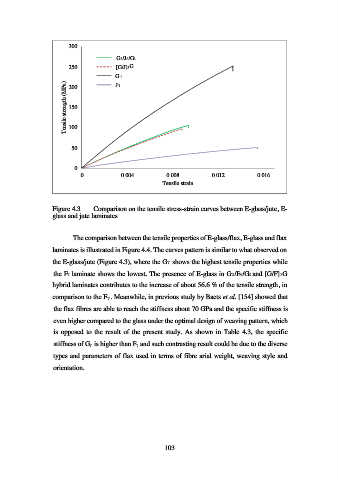
                   Figure 4.3     Comparison on the tensile stress-strain curves between E-glass/jute, E-
                   glass and jute laminates


                           The comparison between the tensile properties of E-glass/flax, E-glass and flax

                   laminates is illustrated in Figure 4.4. The curves pattern is similar to what observed on
                   the E-glass/jute (Figure 4.3), where the G7 shows the highest tensile properties while


                   the F7 laminate shows the lowest. The presence of E-glass in G2/F3/G2 and [G/F]3G
                   hybrid laminates contributes to the increase of about 56.6 % of the tensile strength, in
                   comparison to the F7. Meanwhile, in previous study by Baets et al. [154] showed that

                   the flax fibres are able to reach the stiffness about 70 GPa and the specific stiffness is
                   even higher compared to the glass under the optimal design of weaving pattern, which

                   is  opposed to  the result of the present  study. As  shown in  Table  4.3, the specific

                   stiffness of G7 is higher than F7 and such contrasting result could be due to the diverse
                   types and parameters of flax used in terms of fibre arial weight, weaving style and

                   orientation.


                                                           103

