


Page 134 - Template Tesis UTM v2.0
P. 134
300

                                       S3 2/F3/G2
                                        G
                         250
                                       S6
                                        [G/F]3G

                                       S7 7
                                              G
                        Tensile strength (MPa)  150
                         200
                                       S10
                                        F7


                         100


                          50


                           0
                             0              0.005             0.01            0.015             0.02
                                                          Tensile strain


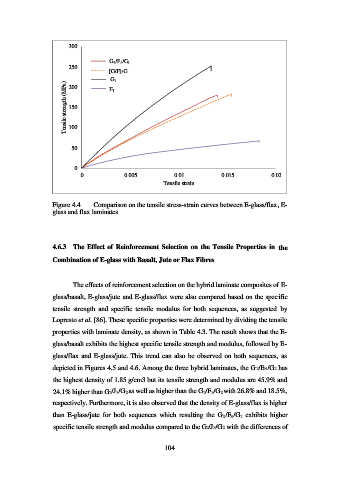
                   Figure 4.4     Comparison on the tensile stress-strain curves between E-glass/flax, E-
                   glass and flax laminates


                   4.6.3  The Effect of Reinforcement Selection on the Tensile Properties  in the

                   Combination of E-glass with Basalt, Jute or Flax Fibres


                           The effects of reinforcement selection on the hybrid laminate composites of E-
                   glass/basalt, E-glass/jute and E-glass/flax were also compared based on the specific

                   tensile  strength  and  specific  tensile  modulus  for  both  sequences,  as  suggested  by
                   Lopresto et al. [86]. These specific properties were determined by dividing the tensile

                   properties with laminate density, as shown in Table 4.3. The result shows that the E-
                   glass/basalt exhibits the highest specific tensile strength and modulus, followed by E-

                   glass/flax and E-glass/jute. This trend can also  be observed on both sequences,  as

                   depicted in Figures 4.5 and 4.6. Among the three hybrid laminates, the G2/B3/G2 has
                   the highest density of 1.85 g/cm3 but its tensile strength and modulus are 45.9% and

                   24.1% higher than G2/J3/G2 as well as higher than the G2/F3/G2 with 26.8% and 18.5%,

                   respectively. Furthermore, it is also observed that the density of E-glass/flax is higher
                   than  E-glass/jute  for  both  sequences  which  resulting  the  G2/F3/G2  exhibits  higher

                   specific tensile strength and modulus compared to the G2/J3/G2 with the differences of


                                                           104

