


Page 57 - Template Tesis UTM v2.0
P. 57
including  recycling  and  ultimate  disposal.  For  instance,  in  the    United  States,

                   manufacturers are encouraged to produce materials and products by practicing the 4Rs,
                   (i) Reduce the amount and toxicity of trash to be discarded (sourced reduction); (ii)

                   Reuse containers and products; (iii) Repair what is broken, and (iv) Recycle as much
                   as possible as well as buying products with recycled contents [52].


                           In this light, natural fibre composites have dominantly been used to produce

                   upscale interior for mid-range and luxury cars due to their advantages such as lower
                   density which is preferable for lightweight structures, deformation and crash behaviour

                   resistance as well as ease of drapability. The use of such composites often depends on
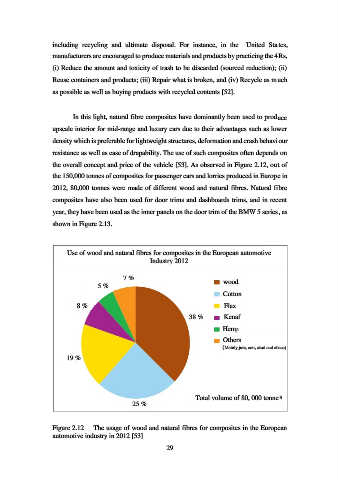
                   the overall concept and price of the vehicle [53]. As observed in Figure 2.12, out of

                   the 150,000 tonnes of composites for passenger cars and lorries produced in Europe in
                   2012, 80,000 tonnes were made of different wood and natural fibres. Natural fibre

                   composites have also been used for door trims and dashboards trims, and in recent

                   year, they have been used as the inner panels on the door trim of the BMW 5 series, as
                   shown in Figure 2.13.


                         Use of wood and natural fibres for composites in the European automotive
                                                      Industry 2012


                                            7 %                                wood
                                   5 %
                                                                               Cotton
                            8 %                                                Flax

                                                                   38 %        Kenaf
                                                                               Hemp

                                                                               Others
                                                                               (Mainly jute, coir, sisal and abaca)

                        19 %


                                                                      Total volume of 80, 000 tonnes
                                               25 %


                   Figure 2.12    The usage of wood and natural fibres for composites in the European
                   automotive industry in 2012 [53]
                                                           29

