


Page 53 - Template Tesis UTM v2.0
P. 53
On the other hand, in spite of their favourable properties, natural fibres have a

                   few  disadvantages  like  the  lack  of  thermal  stability,  strength  degradation,  water
                   absorption and poor impact properties.


                   2.6.1  Basalt fibre


                           Basalt fibre is a reinforcement made of basalt rock, which is a common grey or

                   black coloured volcanic rock. This kind of fibres are environmentally friendly, less

                   hazardous and can be produced by a similar process to glass. Due to the rapid cooling
                   of lava, basalt fibres are fine-grained and can be produced by melting basalt rock at

                   temperature between 1300 to 1700 °C with no other additives. During processing, only
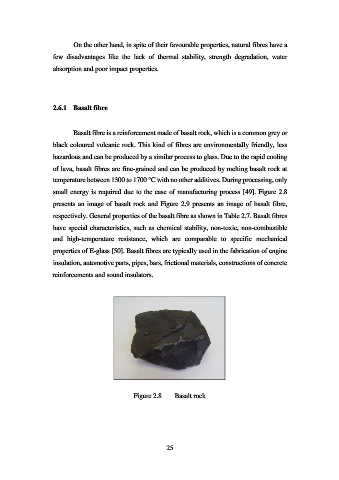
                   small energy is required due to the ease of manufacturing process [49]. Figure 2.8

                   presents an image of basalt rock and Figure 2.9 presents an image of basalt fibre,
                   respectively. General properties of the basalt fibre as shown in Table 2.7. Basalt fibres

                   have special characteristics, such as chemical stability, non-toxic, non-combustible

                   and  high-temperature  resistance,  which  are  comparable  to  specific  mechanical
                   properties of E-glass [50]. Basalt fibres are typically used in the fabrication of engine

                   insulation, automotive parts, pipes, bars, frictional materials, constructions of concrete
                   reinforcements and sound insulators.


                                                Figure 2.8    Basalt rock


                                                           25

