


Page 93 - Template Tesis UTM v2.0
P. 93
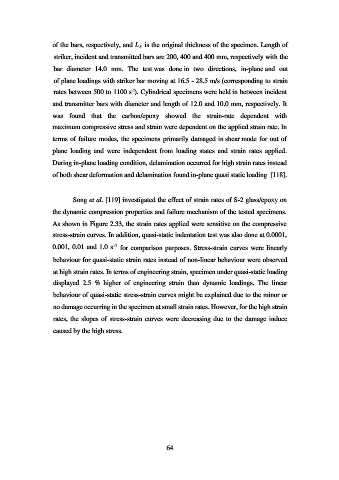
of the bars, respectively, and     is the original thickness of the specimen. Length of

                   striker, incident and transmitted bars are 200, 400 and 400 mm, respectively with the
                   bar  diameter  14.0  mm.  The  test was  done in  two  directions,  in-plane and  out

                   of plane loadings with striker bar moving at 16.5 - 28.5 m/s (corresponding to strain
                                               -1
                   rates between 500 to 1100 s ). Cylindrical specimens were held in between incident
                   and transmitter bars with diameter and length of 12.0 and 10.0 mm, respectively. It
                   was  found  that  the  carbon/epoxy  showed  the  strain-rate  dependent  with

                   maximum compressive stress and strain were dependent on the applied strain rate. In

                   terms of failure modes, the specimens primarily damaged in shear mode for out of
                   plane  loading  and  were  independent  from  loading  states  and  strain  rates  applied.

                   During in-plane loading condition, delamination occurred for high strain rates instead

                   of both shear deformation and delamination found in-plane quasi static loading  [118].


                           Song et al. [119] investigated the effect of strain rates of S-2 glass/epoxy on

                   the dynamic compression properties and failure mechanism of the tested specimens.
                   As shown in Figure 2.33, the strain rates applied were sensitive on the compressive

                   stress-strain curves. In addition, quasi-static indentation test was also done at 0.0001,
                                         -1
                   0.001, 0.01 and 1.0 s  for comparison purposes. Stress-strain curves were linearly
                   behaviour for quasi-static strain rates instead of non-linear behaviour were observed
                   at high strain rates. In terms of engineering strain, specimen under quasi-static loading

                   displayed  2.5  %  higher  of  engineering  strain  than  dynamic  loadings.  The  linear

                   behaviour of quasi-static stress-strain curves might be explained due to the minor or
                   no damage occurring in the specimen at small strain rates. However, for the high strain

                   rates, the slopes of stress-strain curves  were decreasing due to the damage induce

                   caused by the high stress.


                                                           64

