


Page 15 - Spotlight A+ Physics Form 4.5
P. 15
Form
           5         Physics   Chapter 3 Electricity


              Conclusion:
              Different material has different resistivity and gives different resistance. When the resistivity of a material
              increases, its resistance also increases. The hypothesis is accepted.


               Assume the conductors as a road and the current as a car you are driving in. Constantan wire is as if an old road
                     ©PAN ASIA PUBLICATIONS
                    ©PAN ASIA PUBLICATIONS
               with potholes and badly damaged, copper is as if a newly built road and tungsten is as if uneven road. The
               different road (different wires) gives you different obstructions (resistance) to drive through them. Old road
               with potholes and badly damaged (constantan) is most difficult to drive through due to a lot of obstructions
               (high resistance). Newly built road (copper) is easiest to drive through because it gives very little obstruction
               (resistance).


        CHAP
        3     Application of Resistivity of Conductor in Daily life

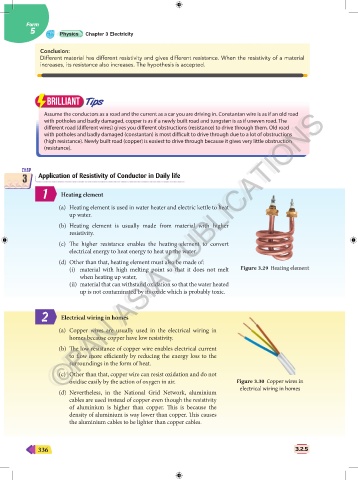
              1      Heating element

                    (a)  Heating element is used in water heater and electric kettle to heat
                        up water.
                    (b)  Heating element is usually made from material with higher
                        resistivity.

                    (c)  The higher resistance enables the heating element to convert
                        electrical energy to heat energy to heat up the water.
                    (d)  Other than that, heating element must also be made of:
                        (i)  material  with high melting  point  so  that it  does  not  melt   Figure 3.29  Heating element
                           when heating up water,
                        (ii)  material that can withstand oxidation so that the water heated
                           up is not contaminated by its oxide which is probably toxic.


              2      Electrical wiring in homes

                    (a)  Copper wires are usually used in the electrical wiring in
                        homes because copper have low resistivity.
                    (b)  The low resistance of copper wire enables electrical current
                        to flow more efficiently by reducing the energy loss to the
                        surroundings in the form of heat.
                    (c)  Other than that, copper wire can resist oxidation and do not
                        oxidise easily by the action of oxygen in air.        Figure 3.30  Copper wires in
                                                                               electrical wiring in homes
                    (d)  Nevertheless, in the National Grid Network, aluminium
                        cables are used instead of copper even though the resistivity
                        of  aluminium  is  higher  than  copper.  This  is  because  the
                        density of aluminium is way lower than copper. This causes
                        the aluminium cables to be lighter than copper cables.


             336                                                                                 3.2.5

