


Page 14 - Spotlight A+ Physics Form 4.5
P. 14
Form
                                                                                                          5
                                                                         Chapter 3 Electricity   Physics

                                         3.4

                  Aim: To investigate how the resistivity of a wire, ρ affects its resistance.

                  Problem statement: How the resistivity of a wire, ρ affects the resistance of the wire?
                  Hypothesis: Materials with high resistivity gives higher resistance.
                  Variables:
                  (a)  Manipulated: Resistivity of wire, ρ
                  Discussions: ©PAN ASIA PUBLICATIONS
                    ©PAN ASIA PUBLICATIONS
                  (b) Responding: Resistance of wire, R
                  (c)  Constant: Length of wire, temperature, cross-sectional area of wire
                  Apparatus and Materials:
                  50 cm constantan wire (s.w.g. 24), 50 cm copper wire (s.w.g. 24), 50 cm tungsten wire (s.w.g. 24), connecting
                  wires, three dry cells, switch, ammeter (0 – 1 A), voltmeter (0 – 5 V), rheostat and battery holder
                  Operational definition:
                  The resistance of the conductor, R, is given by the ratio of the reading of voltmeter to the reading of the   CHAP
                  ammeter.
                                                                                                            3
                  Procedure:
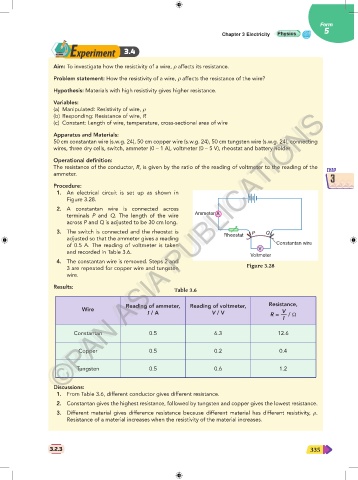
                    1.  An  electrical  circuit  is  set  up  as  shown  in
                       Figure 3.28.
                    2.  A  constantan  wire  is  connected  across
                                                                Ammeter A
                       terminals  P  and  Q.  The  length  of  the  wire
                       across P and Q is adjusted to be 30 cm long.
                    3.  The switch is connected and the rheostat is       Rheostat  P  Q
                       adjusted so that the ammeter gives a reading
                       of 0.5 A. The reading of voltmeter is taken                   V     Constantan wire
                       and recorded in Table 3.6.
                                                                                  Voltmeter
                    4.  The constantan wire is removed. Steps 2 and              Figure 3.28
                       3 are repeated for copper wire and tungsten
                       wire.

                  Results:
                                                          Table 3.6

                                          Reading of ammeter,    Reading of voltmeter,    Resistance,
                            Wire                                                             V
                                                 I / A                V / V              R = — / Ω
                                                                                             I
                         Constantan               0.5                  6.3                 12.6


                           Copper                 0.5                  0.2                  0.4

                          Tungsten                0.5                  0.6                  1.2


                    1.  From Table 3.6, different conductor gives different resistance.
                    2.  Constantan gives the highest resistance, followed by tungsten and copper gives the lowest resistance.
                    3.  Different  material  gives  difference  resistance  because  different  material  has  different  resistivity,  ρ.
                       Resistance of a material increases when the resistivity of the material increases.


                 3.2.3                                                                                335

