


Page 136 - Softcopy for Teachers buku kerja + nota Nilam Publications
P. 136
MODUL • Fizik TINGKATAN 5


                                   Semikonduktor jenis-n / n-type semiconductors
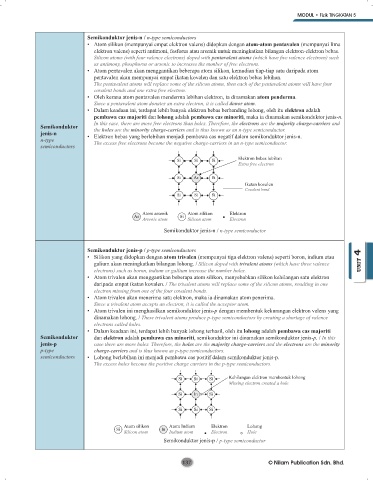
                                   •  Atom silikon (mempunyai empat elektron valens) didopkan dengan atom-atom pentavalen (mempunyai lima
                                     elektron valens) seperti antimoni, fosforus atau arsenik untuk meningkatkan bilangan elektron-elektron bebas.
                                     Silicon atoms (with four valence electrons) doped with pentavalent atoms (which have five valence electrons) such
                                     as antimony, phosphorus or arsenic to increases the number of free electrons.
                                   •  Atom pentavalen akan menggantikan beberapa atom silikon, kemudian tiap-tiap satu daripada atom
                                     pentavalen akan mempunyai empat ikatan kovalen dan satu elektron bebas lebihan.
                                     The pentavalent atoms will replace some of the silicon atoms, then each of the pentavalent atoms will have four
                                     covalent bonds and one extra free electron.
                                   •  Oleh kerana atom pentavalen menderma lebihan elektron, ia dinamakan atom penderma.
                                     Since a pentavalent atom donates an extra electron, it is called donor atom.
                                   •  Dalam keadaan ini, terdapat lebih banyak elektron bebas berbanding lohong, oleh itu elektron adalah
                                     pembawa cas majoriti dan lohong adalah pembawa cas minoriti, maka ia dinamakan semikonduktor jenis-n.
                                     In this case, there are more free electrons than holes. Therefore, the electrons are the majority charge-carriers and
                   Semikonduktor     the holes are the minority charge-carriers and is thus known as an n-type semiconductor.
                   jenis-n         •  Elektron bebas yang berlebihan menjadi pembawa cas negatif dalam semikonduktor jenis-n.
                   n-type            The excess free electrons become the negative charge-carriers in an n-type semiconductor.
                   semiconductors

                                                                 Si    Si    Si       Elektron bebas lebihan
                                                                                      Extra free electron
                                                                 Si    As    Si
                                                                                        Ikatan kovalen
                                                                                        Covalent bond
                                                                 Si    Si    Si


                                                     Atom arsenik   Atom silikon   Elektron
                                                  As              Si
                                                     Arsenic atom   Silicon atom   Electron
                                                             Semikonduktor jenis-n / n-type semiconductor


                                   Semikonduktor jenis-p / p-type semiconductors
                                   •  Silikon yang didopkan dengan atom trivalen (mempunyai tiga elektron valens) seperti boron, indium atau
                                     galium akan meningkatkan bilangan lohong. / Silicon doped with trivalent atoms (which have three valence   UNIT 4
                                     electrons) such as boron, indium or gallium increase the number holes.
 UNIT 4
                                   •  Atom trivalen akan menggantikan beberapa atom silikon, menyebabkan silikon kehilangan satu elektron
                                     daripada empat ikatan kovalen. / The trivalent atoms will replace some of the silicon atoms, resulting in one
                                     electron missing from one of the four covalent bonds.
                                   •  Atom trivalen akan menerima satu elektron, maka ia dinamakan atom penerima.
                                     Since a trivalent atom accepts an electron, it is called the acceptor atom.
                                   •  Atom trivalen ini menghasilkan semikonduktor jenis-p dengan membentuk kekurangan elektron valens yang
                                     dinamakan lohong. / These trivalent atoms produce p-type semiconductors by creating a shortage of valence
                                     electrons called holes.
                                   •  Dalam keadaan ini, terdapat lebih banyak lohong terhasil, oleh itu lohong adalah pembawa cas majoriti
                   Semikonduktor     dan elektron adalah pembawa cas minoriti, semikonduktor ini dinamakan semikonduktor jenis-p. / In this
                   jenis-p           case there are more holes. Therefore, the holes are the majority charge-carriers and the electrons are the minority
                   p-type            charge-carriers and is thus known as p-type semiconductors.
                   semiconductors  •  Lohong berlebihan ini menjadi pembawa cas positif dalam semikonduktor jenis-p.
                                     The excess holes become the positive charge carriers in the p-type semiconductors.


                                                                 Si    Si   Si    Kehilangan elektron membentuk lohong
                                                                                  Missing electron created a hole
                                                                 Si    In   Si

                                                                 Si    Si   Si


                                               Atom silikon   Atom Indium   Elektron     Lohong
                                            Si  Silicon atom  In  Indium atom  Electron  Hole
                                                            Semikonduktor jenis-p / p-type semiconductor


                                                                   137                          © Nilam Publication Sdn. Bhd.

