


Page 137 - Softcopy for Teachers buku kerja + nota Nilam Publications
P. 137
MODUL • Fizik TINGKATAN 5


                                            Perbandingan antara semikonduktor jenis-n dan jenis-p
                                      The comparison between the n-type semiconductor and p-type semiconductor
                                Aspek                       Semikonduktor jenis-n            Semikonduktor jenis-p
                                Aspect                        n-type semiconductor             p-type semiconductor
                Ketulenan semikonduktor               Tidak tulen                      Tidak tulen
                The purity of semiconductor           Not pure                         Not pure

                Jenis atom pendop yang digunakan      Atom pentavalen                            Atom trivalen
                The type of dopant atom used          Pentavalent atom                           Trivalent atom


                                                      (i)   fosforus / phosphorus      (i)   boron
                Contoh-contoh atom pendop yang digunakan  (ii)  arsenik / arsenic      (ii)  indium
                The examples of dopant atom used
                                                      (iii) antimoni / antimony        (iii) gallium

                Kesan ke atas kekonduksian elektrik   Meningkat / menjadi lebih baik   Meningkat / menjadi lebih baik
                The effect on electrical conductivity  Increases / becomes better      Increases / becomes better

                Bilangan elektron valens atom pendop  5 elektron                       3 elektron
                The number of valence electron of dopant atom  5 electrons             3 electrons

                Pembawa cas majoriti                       Elektron bebas (cas negatif)  Lohong (cas positif)
                The majority charge carrier               Free electrons (negatively charged)  Holes (positively charged)

                Pembawa cas minoriti                  Lohong (cas positif)                  Elektron bebas (cas negatif)
                The minority charge carrier           Holes (positively charged)           Free electrons (negatively charged)


                Diod semikonduktor / Semiconductor diodes
                                                                                                                                                                                                                                                         UNIT 4

                                •  Apabila bahan semikonduktor jenis-p bercantum dengan bahan semikonduktor jenis-n, ini akan membentuk
         UNIT 4
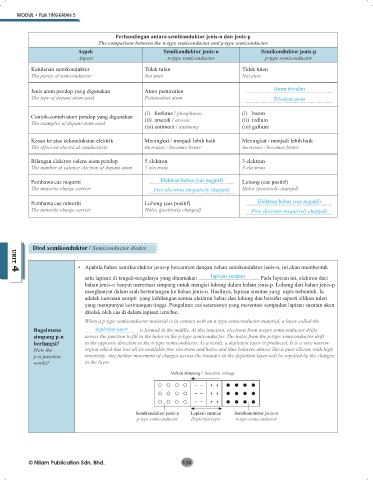
                                  satu lapisan di tengah-tengahnya yang dinamakan   lapisan susutan  . Pada lapisan ini, elektron dari
                                  bahan jenis-n hanyut merentasi simpang untuk mengisi lohong dalam bahan jenis-p. Lohong dari bahan jenis-p
                                  menghanyut dalam arah bertentangan ke bahan jenis-n. Hasilnya, lapisan susutan yang  nipis terbentuk. Ia
                                  adalah kawasan sempit  yang kehilangan semua elektron bebas dan lohong dan bersifat seperti silikon tulen
                                  yang mempunyai kerintangan tinggi. Pengaliran cas seterusnya yang merentasi sempadan lapisan susutan akan
                                  ditolak oleh cas di dalam lapisan tersebut.
                                  When a p-type semiconductor material is in contact with an n-type semiconductor material, a layer called the
                 Bagaimana           depletion layer   is formed in the middle. At this junction, electrons from n-type semiconductor drifts
                 simpang p-n      across the junction to fill in the holes in the p-type semiconductor. The holes from the p-type semiconductor drift
                 berfungsi?       in the opposite direction to the n-type semiconductor. As a result, a depletion layer is produced. It is a very narrow
                 How the          region which has lost all its available free electrons and holes and thus behaves almost like a pure silicon, with high
                 p-n junction     resistivity. Any further movement of charges across the boundry in the depletion layer will be repelled by the charges
                 works?           in the layer.
                                                               Voltan simpang / Junction voltage


                                                   Semikonduktor jenis-p  Lapisan susutan  Semikonduktor jenis-n
                                                   p-type semiconductor  Depletion layer  n-type semiconductor


               © Nilam Publication Sdn. Bhd.                       138

