


Page 79 - Chronicles of Darkness
P. 79
shoulders. It will also help to cater the story to their specific
                 interests and biases. When they succeed, ask them, “What do
                 you find?” and let their answers inform the direction of your   Investigation
                 story. If you have a culprit in mind, that’s fine. However, let
                 the players help guide the path to that culprit if at all possible.   Quick Reference
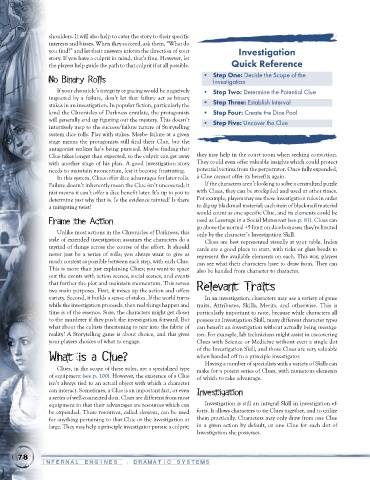
                 No Binary Rolls                                    •  Step One: Decide the Scope of the
                                                                       Investigation
                    If your chronicle’s integrity or pacing would be negatively   •  Step Two: Determine the Potential Clue
                 impacted by a failure, don’t let that failure act as binary
                 stakes in an investigation. In popular fiction, particularly the   •  Step Three: Establish Interval
                 kind the Chronicles of Darkness emulate, the protagonists   •  Step Four: Create the Dice Pool
                 will generally end up figuring out the mystery. This doesn’t   •  Step Five: Uncover the Clue
                 intuitively map to the success/failure nature of Storytelling
                 system dice rolls. Play with stakes. Maybe failure at a given
                 stage means the protagonists still find their Clue, but the
                 antagonist realizes he’s being pursued. Maybe finding that
                 Clue takes longer than expected, so the culprit can get away   they may help in the court room when seeking conviction.
                 with another stage of his plan. A good investigation story   They could even offer valuable insights which could protect
                 needs to maintain momentum, lest it become frustrating.  potential victims from the perpetrator. Once fully expended,
                    In this system, Clues offer dice advantages for later rolls.   a Clue cannot offer its benefits again.
                 Failure doesn’t inherently mean the Clue isn’t uncovered; it   If the characters aren’t looking to solve a centralized puzzle
                 just means it can’t offer a dice benefit later. It’s up to you to   with Clues, they can be stockpiled and used at other times.
                 determine just why that is. Is the evidence tainted? Is there   For example, players may use these investigation rules in order
                 a mitigating twist?                              to dig up blackmail material; each item of blackmail material
                                                                  would count as one specific Clue, and its elements could be
                 Frame the Action                                 used as Leverage in a Social Maneuver (see p. 81). Clues can
                                                                  go above the normal +5 limit on dice bonuses; they’re limited
                    Unlike most actions in the Chronicles of Darkness, this   only by the character’s Investigation Skill.
                 style of extended investigation assumes the characters do a   Clues are best represented visually at your table. Index
                 myriad of things across the course of the effort. It should   cards are a good place to start, with ticks or glass beads to
                 never just be a series of rolls; you always want to give as   represent the available elements on each. This way, players
                 much context as possible between each step, with each Clue.   can see what their characters have to draw from. They can
                 This is more than just explaining Clues; you want to space   also be handed from character to character.
                 out the events with action scenes, social scenes, and events
                 that further the plot and maintain momentum. This serves   Relevant Traits
                 two main purposes. First, it mixes up the action and offers
                 variety. Second, it builds a sense of stakes. If the world turns   In an investigation, characters may use a variety of game
                 while the investigation proceeds, then real things happen and  traits, Attributes, Skills, Merits, and otherwise. This is
                 time is of the essence. Sure, the characters might get closer  particularly important to note, because while characters all
                 to the murderer if they push the investigation forward. But  possess an Investigation Skill, many different character types
                 what about the cultists threatening to tear into the fabric of  can benefit an investigation without actually being investiga-
                 reality? A Storytelling game is about choice, and this gives  tors. For example, lab technicians might assist in uncovering
                 your players choices of what to engage.          Clues with Science or Medicine without even a single dot
                 What is a Clue?                                  of the Investigation Skill, and those Clues are very valuable
                                                                  when handed off to a principle investigator.
                                                                     Having a number of specialists with a variety of Skills can
                    Clues, in the scope of these rules, are a specialized type   make for a potent series of Clues, with numerous elements
                 of equipment (see p. 100). However, the existence of a Clue   of which to take advantage.
                 isn’t always tied to an actual object with which a character
                 can interact. Sometimes, a Clue is an important fact, or even   Investigation
                 a series of well-connected dots. Clues are different from most
                 equipment in that their advantages are resources which can   Investigation is still an integral Skill in investigation ef-
                 be expended. These resources, called elements, can be used   forts. It allows characters to tie Clues together, and to utilize
                 for anything pertaining to that Clue or the investigation at   them practically. Characters may only draw from one Clue
                 large. They may help a principle investigator pursue a culprit;   in a given action by default, or one Clue for each dot of
                                                                  Investigation she possesses.


       78
               infernal engines -dramatic systems

