


Page 45 - 2010-2022 hose manufactureing ability and guide
P. 45
Woven Hose                                     A hose made with this loom normally would be
                                                                provided with an inner  liner which would  be
                     The reinforcement for  woven hose  is a
                 seamless, tubular textile  jacket  woven on  a   drawn  into the circular woven  member
                 loom. This produces a strong, lightweight hose   simultaneously with the weaving procedure.
                 that is  flexible  for flat storage.  Because  the   The primary use of a hose from such a loom is
                                                                for  suction applications. This construction
                 longitudinal warp yarns are parallel to the axis,
                 woven hose tends to kink more easily than other   would normally have two alternate members of
                 hose constructions. Although sometimes used    round wire  or plastic  rods having physical
                                                                characteristics which would provide substantial
                 with a rubber cover for industrial applications,
                 woven discharge hose finds its greatest use as a   crush resistance in the hose structure. The other
                 fire hose where  lightweight and high  strength   two would be textile yarn. An illustration of the
                                                                Chernack loom construction is shown in Figure
                 are of great importance.
                                                                2-17.
                     Fire  hose  consists of a  tube  and  seamless
                 circular woven jacket or jackets, either separate
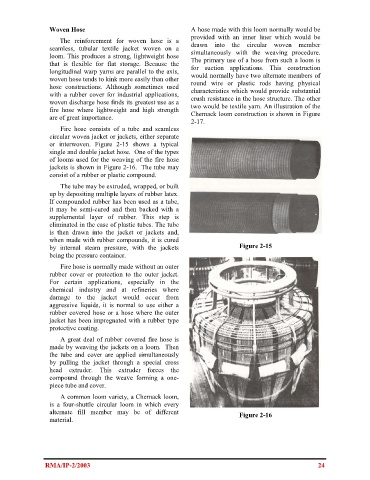
                 or interwoven.  Figure 2-15 shows a  typical
                 single and double jacket hose.  One of the types
                 of looms used for the weaving of the fire hose
                 jackets is shown in Figure 2-16.  The tube may
                 consist of a rubber or plastic compound.

                     The tube may be extruded, wrapped, or built
                 up by depositing multiple layers of rubber latex.
                 If compounded rubber has been used as a tube,
                 it  may be  semi-cured and then  backed with  a
                 supplemental  layer of rubber. This  step  is
                 eliminated in the case of plastic tubes. The tube
                 is then  drawn into  the  jacket or  jackets and,
                 when made with rubber compounds, it is cured
                 by internal steam pressure, with the jackets                   Figure 2-15
                 being the pressure container.
                     Fire hose is normally made without an outer
                 rubber  cover  or  protection to the outer  jacket.
                 For  certain applications,  especially in  the
                 chemical  industry  and at refineries  where
                 damage to the jacket would  occur from
                 aggressive liquids,  it  is normal  to use  either  a
                 rubber covered hose or a hose where the outer
                 jacket has been impregnated with a rubber type
                 protective coating.
                     A great deal of rubber covered fire hose is
                 made by weaving the jackets on a loom.  Then
                 the  tube and cover are  applied  simultaneously
                 by  pulling the  jacket through a special  cross
                 head extruder. This extruder  forces  the
                 compound  through the  weave  forming a one-
                 piece tube and cover.
                     A common loom variety, a Chernack loom,
                 is a four-shuttle circular loom in which  every
                 alternate fill  member may be of different                     Figure 2-16
                 material.


                RMA/IP-2/2003                                                                             24

