


Page 46 - 2010-2022 hose manufactureing ability and guide
P. 46
The lead sheath is applied as a hot extrusion
                                                                through a set of dies. Its purpose is to compress
                                                                the  hose components thereby providing  good
                                                                bonding  or homogeneous structure  with
                                                                adequate  concentric dimensions. This method
                                                                can be used for non-mandrel or flexible mandrel
                                                                constructions.   For non-mandrel  styles, air  or
                                                                water is charged inside the  hose for  support
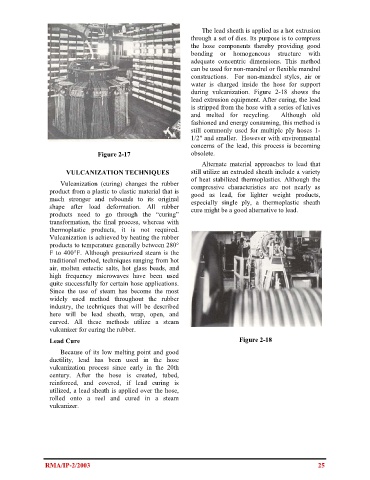
                                                                during  vulcanization. Figure 2-18 shows the
                                                                lead extrusion equipment. After curing, the lead
                                                                is stripped from the hose with a series of knives
                                                                and melted for  recycling.   Although  old
                                                                fashioned and energy consuming, this method is
                                                                still  commonly used  for multiple pIy hoses  1-
                                                                1/2" and smaller.  However with environmental
                                                                concerns  of the  lead, this process  is becoming
                                 Figure 2-17                    obsolete.
                                                                    Alternate  material  approaches to lead that
                       VULCANIZATION TECHNIQUES                 still utilize an extruded sheath include a variety
                                                                of  heat stabilized thermoplastics.  Although  the
                     Vulcanization (curing) changes the rubber   compressive characteristics  are  not nearly as
                 product from a plastic to elastic material that is   good as lead, for  lighter weight products,
                 much stronger  and rebounds  to  its original   especially single ply, a thermoplastic sheath
                 shape after  load  deformation. All rubber     cure might be a good alternative to lead.
                 products need to  go  through the “curing”
                 transformation, the final process, whereas with
                 thermoplastic  products,  it is not  required.
                 Vulcanization is achieved by heating the rubber
                 products to temperature generally between 280°
                 F  to 400°F.  Although  pressurized steam is  the
                 traditional method, techniques ranging from hot
                 air, molten eutectic  salts, hot glass beads, and
                 high  frequency  microwaves have been  used
                 quite successfully for certain hose applications.
                 Since the use of steam has become the most
                 widely used method  throughout  the rubber
                 industry, the  techniques  that will  be described
                 here will be lead  sheath, wrap, open, and
                 curved. All these methods  utilize a steam
                 vulcanizer for curing the rubber.

                 Lead Cure                                                      Figure 2-18
                     Because of its low melting point and good
                 ductility, lead  has  been used in the hose
                 vulcanization  process  since early in the 20th
                 century. After  the  hose  is created,  tubed,
                 reinforced, and covered,  if lead curing is
                 utilized, a lead sheath is applied over the hose,
                 rolled onto a reel  and cured  in  a  steam
                 vulcanizer.


                RMA/IP-2/2003                                                                             25

